
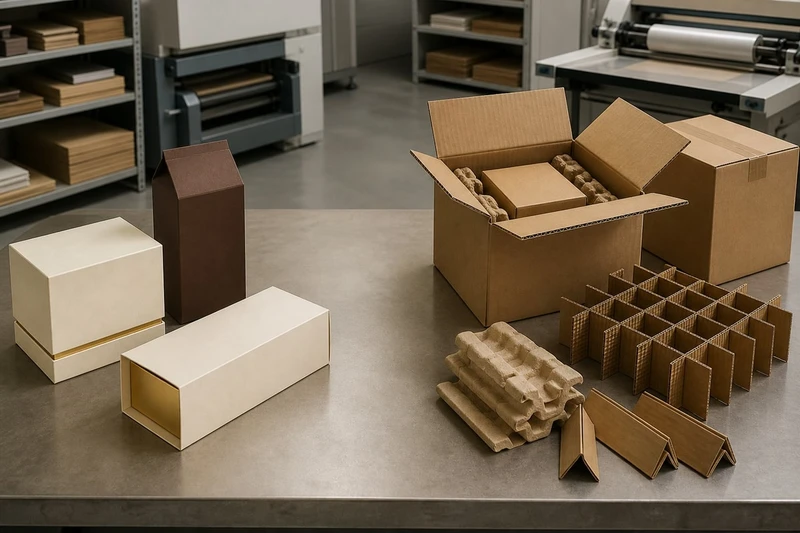
Retail packaging and shipping packaging serve different jobs. Retail packaging sells, informs and protects a product where it is displayed. Shipping packaging protects the packed order through storage, handling, transport and delivery. A visually refined retail box may not survive a courier network on its own, while a plain corrugated shipper rarely creates the right first impression on a shelf or at unboxing.
The best approach is to design the full packaging system around the product’s route: factory or warehouse, retail shelf or fulfilment centre, carrier network, customer, and potentially a return trip. In some cases, one pack can perform both roles. In many others, a branded primary pack needs a separate transit carton and protective internal materials.
Define primary, secondary and transit packaging
Packaging decisions become easier when every layer has a clear function. The terms are sometimes used differently between businesses, so agree on definitions in your product specification before requesting quotes or approving artwork.
| Packaging layer | Main purpose | Typical examples | Usually seen by the customer? |
|---|---|---|---|
| Primary packaging | Holds or directly protects the product | Folding carton, rigid gift box, bottle label, pouch, sleeve | Yes |
| Secondary packaging | Groups primary packs for sale, storage or display | Multipack carton, retail-ready tray, inner carton | Sometimes |
| Transit packaging | Protects products through distribution and delivery | Corrugated shipping box, mailer, pallet carton, protective inserts | Usually, for e-commerce orders |
A skincare jar may sit in a branded folding carton as its primary packaging. Several cartons may be packed into an outer carton for retailer replenishment. For online orders, that retail carton might then go into a corrugated shipper with cushioning and a tamper-evident seal.
Not every product needs all three layers. A low-risk apparel item, for example, may use a branded mailing bag that serves as both primary and transit packaging. A fragile gift product will usually need separate presentation and shipping layers.
The key question is not “Which box looks best?” It is: which packaging layer owns each risk?
Separate shelf and delivery risks
Retail and delivery environments expose packaging to different types of pressure. Designing for one environment without considering the other can lead to damage, excess cost, awkward opening or poor shelf appeal.
Retail packaging must attract, inform and fit the shelf
Retail packaging often has to communicate quickly. Shoppers may see only the front panel, a shelf edge or a thumbnail image online before deciding whether to look closer.
A retail pack should be designed around:
- Brand recognition: Colours, finish, logo placement and shape should support quick identification.
- Product information: Include the information your product category requires, plus clear usage, contents, size and handling details where relevant.
- Shelf presence: The pack must fit display dimensions, face forward neatly and retain its shape while stocked.
- Product access: Customers should be able to understand how to open the pack without damaging it unnecessarily.
- Theft and tamper considerations: Depending on the product, seals, locking tabs or retailer security requirements may be relevant.
- Point-of-sale handling: Store staff may open master cartons, place products on shelves and handle individual boxes repeatedly.
Retail boxes are often made to look and feel premium, using printed paperboard, coatings, embossing, foiling, windows or rigid-board construction. These features can be valuable for brand experience, but they do not automatically provide enough protection for transport.
Shipping packaging must survive the distribution journey
Shipping packaging needs to manage impacts, compression, vibration, moisture exposure and variable handling. A parcel may be loaded, stacked, moved between vehicles, left at a collection point or carried by the recipient after delivery.
Shipping packaging should account for:
- Drop and impact exposure: Particularly at corners, edges and seams.
- Stacking pressure: Parcels can be placed beneath heavier consignments.
- Vibration: Road transport can cause products to shift, rub or settle inside a carton.
- Moisture and dirt: Conditions may vary while parcels move through depots, vehicles and collection points.
- Handling variation: Even clear handling instructions should not be the only protection for fragile goods.
- Address labels and barcode space: The outer pack needs a clean, flat area for operational labels.
- Dimensional efficiency: Extra volume can raise storage and shipping costs, especially for e-commerce fulfilment.
In South Africa, delivery routes can involve long distances, multiple handling points and changing weather conditions. That makes a realistic packed-system test especially important for products that are heavy, breakable, leak-prone or sensitive to scuffing.
Retail packaging vs shipping packaging at a glance
| Design consideration | Retail packaging | Shipping packaging |
|---|---|---|
| Primary goal | Present the product and support purchase | Protect the order during fulfilment and delivery |
| Typical material | Paperboard, rigid board, labels, flexible packs | Corrugated board, mailers, protective paper, inserts |
| Visual priority | High: branding, product information and shelf appeal | Functional first, with branding where it adds value |
| Protection level | Suitable for store handling and product containment | Suitable for impact, stacking, vibration and movement |
| Size focus | Shelf fit, product fit and visual proportions | Product fit, void reduction and carrier efficiency |
| Opening experience | Convenient, presentable and often reusable | Secure but reasonably easy to open without damaging contents |
| Information needed | Product identity, usage and retail-facing details | Delivery label space, handling instructions and returns information |
| Common failure | Attractive box crushes or scuffs in transit | Durable carton feels oversized, wasteful or impersonal |
A useful rule is simple: retail packaging protects the product’s presentation; shipping packaging protects the product and its presentation.
Decide when one pack can do both jobs
Using one package for retail display and direct shipping can reduce material use, packing steps and storage complexity. However, it is only a good decision when the pack performs both functions without creating avoidable damage or customer frustration.
A dual-purpose pack may work when the product is:
- Lightweight and not easily crushed
- Not fragile, liquid-filled or prone to scratching
- Already protected by its own durable construction
- Sold directly to customers rather than displayed extensively in stores
- Able to fit securely in a purpose-designed corrugated mailer or robust mailing box
- Unlikely to need an elaborate gift-style presentation
For example, a sturdy clothing box with an integrated self-seal closure may work well for direct-to-consumer dispatch. It can carry branding on the outside, protect folded garments and provide a tidy unboxing experience without an additional shipper.
A single pack is less suitable when:
- The retail box uses fine finishes that scuff easily.
- The product has glass, ceramic, sharp edges or delicate components.
- The pack contains loose items that can move during transport.
- The outer surface is intended to remain pristine for gifting.
- Retailers require separate outer cartons for replenishment.
- The product needs protective spacing from the outer walls of the parcel.
- Shipping labels would cover important branding or mandatory product information.
A common compromise is a branded corrugated mailer with a printed interior, combined with a simpler product carton or protective wrap. This keeps the outer parcel durable while retaining a considered opening experience.
Avoid treating a retail box as a courier box
Sending a retail carton with a delivery label applied directly to it may seem efficient, but it can create several problems:
- Corners and print finishes can be damaged before the customer sees the product.
- Labels may obscure branding or opening instructions.
- The pack may burst at seams under pressure.
- The product may move inside the box.
- Returns become harder if the original pack cannot be resealed.
- A gift-ready product may arrive looking like a handled parcel rather than a premium item.
If direct labelling is under consideration, test the exact production pack with the actual product inside, not an empty sample.
Plan void space, seals and returns
The internal packing design is as important as the outer box. A strong carton cannot fully compensate for a product that slides, knocks against other items or sits too close to the box walls.
Use void space deliberately
Void space is the empty volume between the product and the shipping carton. Some space is necessary for protective materials, but too much can increase movement, material use and freight volume.
Aim for a pack that:
- Holds the product firmly enough to limit movement.
- Leaves room for cushioning where impact protection is needed.
- Keeps fragile items away from carton walls and corners.
- Uses right-sized outer dimensions rather than filling a large box with excessive void fill.
- Allows the fulfilment team to pack consistently and quickly.
Suitable protective options depend on the product. Paper cushioning, corrugated inserts, die-cut dividers, moulded pulp, foam and air-filled materials all have different strengths. Consider the product’s weight, shape, surface sensitivity, recyclability goals and packing process before choosing.
For multiple items in one parcel, separate products that could rub, leak or collide. A divider or fitted insert may cost more than loose fill, but it can improve consistency and reduce damage risk.
Choose seals for the journey and the opening
Sealing must balance security, packing speed and customer convenience. A seal that is too weak can fail in transit; one that is difficult to open may lead customers to use a blade near the product.
Review:
- The box closure style: tuck flap, self-locking base, adhesive strip or tape.
- The product weight and likely stacking load.
- Whether the package needs evidence of opening.
- Whether the customer should be able to reseal it.
- Whether a returns label or secondary adhesive strip is needed.
- Whether the packer can apply the seal consistently.
For e-commerce orders, a tear strip can improve opening, while a second adhesive strip can help with returns. These features need to be tested with the actual board grade, closure design and product weight; their usefulness varies significantly by application.
Make returns practical, not an afterthought
Returns packaging is particularly relevant for apparel, accessories, subscription products and any product with a high likelihood of fit, preference or gifting-related returns.
A return-friendly pack should be:
- Easy to open without destroying the box
- Capable of being resealed securely
- Large enough for the customer to repack the item without struggle
- Clear about what should be returned and how it should be protected
- Durable enough for a second delivery journey where appropriate
Do not assume that a premium rigid box is suitable as a return shipper. It may be reusable as a product box, but it often still needs a protective outer carton for the return journey.
Test the full packed system
Packaging should be assessed as a system, not as separate samples. A board sample, printed box blank or unfilled mailer cannot reveal how the pack will behave once it contains the finished product.
Test the final configuration, including:
- The production-intent product
- All primary and secondary packaging
- Inserts, wraps and void fill
- Seals, tape and labels
- The selected shipping carton or mailer
- The expected maximum packed weight
- Multiple products where orders are commonly bundled
A practical testing sequence
Start with internal checks before arranging more formal performance testing where required by your business, retailer or carrier.
- Fit check: Confirm that the product inserts smoothly and sits correctly in the pack.
- Movement check: Shake and rotate the closed pack to identify shifting, rattling or contact points.
- Closure check: Ensure tabs, adhesive strips and tape remain secure under normal handling.
- Compression check: Stack packed cartons as they may be stored or transported, then inspect for crushing and product damage.
- Drop check: Use a controlled procedure that reflects likely handling, paying particular attention to corners and edges.
- Vibration or transport simulation: Assess whether contents settle, abrade or become loose over time.
- Environmental check: Where relevant, assess performance after exposure to expected humidity or temperature variation.
- Opening check: Ask people unfamiliar with the pack to open it safely and inspect whether the intended brand experience survives.
Document failures clearly. Note not only whether the product broke, but also whether the outer box scuffed, the label lifted, the finish marked, the insert collapsed or opening became difficult. These are all valid packaging failures if they affect customer experience, retail readiness or operational cost.
Common testing mistakes
- Testing a box with a lighter sample than the final product
- Testing one unit when orders often contain multiple items
- Ignoring the effect of labels, tape and outer wrapping
- Testing before print finishes and coatings are applied
- Relying on “fragile” markings instead of internal protection
- Changing material, dimensions or inserts after testing without rechecking performance
Balance brand experience with logistics
The strongest packaging is not necessarily the most elaborate. It is the one that meets the product’s protection needs, works efficiently through fulfilment and gives customers an experience that suits the brand.
Start with the non-negotiables:
- Product dimensions, weight and fragility
- Retail display requirements, if applicable
- Expected order quantities and product combinations
- Storage and packing process
- Delivery route and handling exposure
- Desired opening and return experience
- Material, print and finish requirements
- Budget per unit and total packaging cost
Then distinguish between elements that customers value and elements that add cost without solving a real problem. A printed message inside a mailer may improve unboxing more effectively than adding several decorative layers. A well-fitted insert may protect a premium product better than a thicker outer carton alone.
For brands with both retail and e-commerce channels, it is often sensible to create a modular system:
- A consistent retail carton or product pack
- A small range of right-sized transit cartons or mailers
- Standard inserts that work across related product sizes
- Brand elements used selectively where they remain visible to the customer
This approach can protect brand consistency while avoiding the cost and complexity of a unique shipping solution for every SKU.
When specifying materials and finishes, confirm how they will interact with tape, labels, friction, moisture and repeated handling. Matte dark finishes, for instance, can be visually striking but may show scuffing more readily than some alternatives. Similarly, a window can improve shelf visibility but may introduce a weaker area that needs careful structural design.
A specification checklist for your packaging supplier
Before requesting a quote or prototype, prepare a brief that covers the full journey rather than only the box dimensions.
Include:
- Product dimensions, weight and photographs
- Whether the pack is for retail, shipping or both
- Expected delivery and handling conditions
- Required pack orientation
- Quantity per order and common bundle combinations
- Preferred materials and sustainability priorities
- Print areas, colours, finishes and information panels
- Required inserts, dividers or protective wrap
- Closure, tamper evidence and reseal requirements
- Returns requirements
- Retailer requirements, where applicable
- Test criteria and acceptable level of cosmetic damage
A clear brief reduces redesigns and helps suppliers recommend the appropriate structure instead of simply matching an existing box size.
XGolden Print can support brands that need custom packaging boxes designed around both presentation and protection. The most useful starting point is a product sample, accurate dimensions and a description of the intended retail and delivery journey.
FAQ
Can retail packaging be used for shipping?
It can, but only if it is structurally strong enough, closes securely and protects the product through handling and transport. Many retail cartons need a separate corrugated shipper to prevent crushing, scuffing and label damage.
What is the difference between a mailer and a shipping box?
A mailer is usually a lightweight, self-closing pack intended for smaller or less fragile products. A shipping box is typically a corrugated carton designed for greater protection, stacking strength and a wider range of product weights. The right choice depends on product risk, not appearance alone.
How much empty space should be in a shipping box?
There is no universal measurement. Use enough space for appropriate cushioning and clearance from box walls, but not so much that the product moves freely or the parcel becomes unnecessarily large. Test the final packed configuration to confirm performance.
Should shipping packaging be branded?
Branding can improve recognition and the opening experience, but it should not compromise label placement, durability or cost control. Exterior branding is not essential for every shipment; a branded interior, insert or product box may deliver a better balance.
What packaging is best for gift products?
Gift products often need two layers: a presentation-focused primary pack and a protective shipping carton. This preserves the gift-ready appearance while providing the cushioning and structural strength needed for delivery.
The practical next step is to map your product’s complete route and identify where presentation, protection and returns requirements change. With that outline, you can compare structural options and develop a packaging brief that suits both retail and delivery use.
