
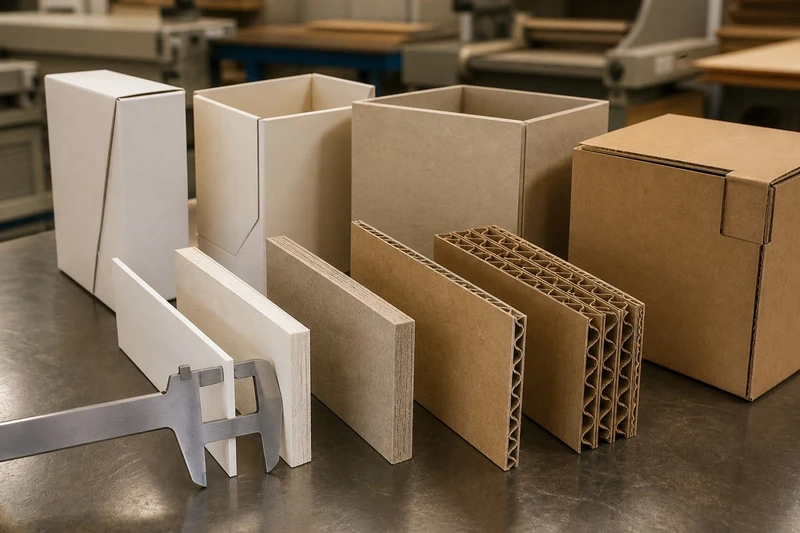
Paperboard thickness and box strength are related, but thickness alone does not tell you whether a box will protect a product. A thicker board may feel more rigid, yet a well-designed carton made from a lower-caliper board can perform better when its fibres, grain direction, folds, construction and product fit are right.
For a reliable specification, compare grammage, caliper, board grade and box design alongside the actual product load and supply-chain conditions. The strongest choice is not necessarily the heaviest board; it is the board-and-structure combination that suits how the pack will be filled, handled, stacked and stored.
Separate grammage, caliper and board grade
These terms are often used interchangeably in packaging discussions, but they measure different things. Treating them as the same can result in a carton that looks substantial but does not perform as expected.
Grammage measures material weight
Grammage is the mass of board per square metre, expressed in grams per square metre (g/m² or gsm). Higher grammage usually means more fibre content, which can contribute to stiffness and durability. However, it is not a direct measure of thickness or box strength.
Two boards with the same 350 gsm can behave differently because of their fibre mix, coating, density and manufacturing process. A dense board may be comparatively thin and firm, while a bulkier board at the same grammage may be thicker but less resistant to a particular type of force.
Grammage is useful for:
- Comparing material weight and potential material usage
- Setting a starting point for a carton specification
- Assessing whether a board is suitable for printing, folding and finishing
- Maintaining consistency across repeat packaging orders
It should not be used alone to predict stacking strength or impact protection.
Caliper measures board thickness
Caliper is the actual thickness of the board, usually measured in microns (µm) or millimetres (mm). It affects how substantial a box feels, its bending stiffness, its ability to resist crushing and the clearance needed for folds, tabs and closures.
A higher caliper can be valuable for presentation boxes, sleeves, larger folding cartons and packs that need to hold their shape on shelf. Yet thickness can also create practical challenges:
- Heavier board can crack on tight folds if the score is unsuitable.
- A thicker carton may need wider crease allowances and adjusted die-cutting.
- It can increase the space required in flat-packed storage and transport.
- An overly stiff carton can be difficult for customers to open or reclose.
Caliper needs to be checked on the actual supplied board, as nominal thickness can vary by grade, moisture condition and production batch.
Board grade describes material composition and performance traits
Board grade refers to the type of paperboard and its construction, not simply its weight or thickness. It influences print appearance, stiffness, folding behaviour, surface feel and tolerance of handling.
Common paperboard options for printed cartons include:
| Board type | Typical characteristics | Often considered for |
|---|---|---|
| Folding boxboard (FBB) | Multi-layer virgin-fibre board with good stiffness for its weight and a printable surface | Cosmetics, food cartons, healthcare packs and retail packaging |
| Solid bleached sulphate (SBS) | Bright white virgin-fibre board, often selected for premium print and finishing | Beauty, gift, confectionery and premium presentation cartons |
| White lined chipboard (WLC) | Recycled-fibre board with a white printable top surface; performance varies by grade | Value-focused retail cartons and secondary packaging |
| Unbleached kraft board | Natural brown appearance and strong fibre character | Natural-brand packaging, sleeves, takeaway-style cartons and selected retail packs |
| Laminated or mounted board | Multiple materials combined to create a thicker, more rigid structure | Rigid gift boxes, luxury packaging and product sets |
The exact trade names and available specifications differ among mills and suppliers. When comparing quotations, ask for the board grade, grammage, caliper and surface or coating specification rather than approving a vague description such as “thick card”.
Why fibre structure matters
Paperboard is made from fibres arranged in layers. Fibre type, length, orientation, density and the way those layers are bonded all affect performance.
Longer virgin fibres often support tear resistance and repeated folding better than some recycled-fibre constructions. Recycled content can be entirely appropriate for many cartons, but its behaviour should be evaluated for the intended use rather than assumed to match a virgin board of equal gsm.
A board’s stiffness can also differ in the machine direction and cross direction. This matters when a carton panel, tuck flap or carry feature needs resistance in one particular direction.
Match board to product load and box style
The product and box structure determine what “strong enough” means. A folding carton holding a lightweight tube has different demands from a pack containing glass jars, metal components or several products packed together.
Start by identifying the load the box must carry and the forces it will face.
Assess the product, not just its mass
Product mass is important, but weight is only one part of the decision. Also consider:
- Product shape: Sharp corners, narrow bases and uneven surfaces can concentrate force on carton panels.
- Product movement: Loose contents can strike side walls and weaken closures during transport.
- Number of units: Multi-packs often create higher loads on the base and end panels.
- Fragility: A carton may provide presentation and containment, while an outer shipper provides transport protection.
- Moisture or oil exposure: Product leakage, condensation or oily surfaces may reduce board performance or affect print.
- Filling method: Manual packing and automated packing can place different stresses on folds and openings.
- Opening frequency: Subscription packs, refill cartons and display boxes may need to survive repeated use.
A compact product can be heavy enough to deform the base of a carton, even where the outer dimensions are small. Conversely, a large but lightweight product may need higher stiffness to prevent panel bowing and maintain a premium appearance.
Select for the style of box
The carton style changes how forces travel through the board.
| Box style | Main strength considerations | Specification checks |
|---|---|---|
| Straight tuck-end carton | End closures, front-panel stiffness and side seam adhesion | Tuck fit, score quality, product clearance and glue area |
| Reverse tuck-end carton | Similar to straight tuck-end, with closure direction affecting packing and presentation | Opening direction, flap overlap and automatic packing suitability |
| Crash-lock or auto-bottom carton | Base must carry the product load and lock securely | Bottom-panel geometry, glue pattern and load testing |
| Sleeve | Needs stiffness to slide over an inner tray or product without crushing | Grain direction, friction, opening clearance and edge durability |
| Hanging carton | Die-cut hole and top panel carry the load | Reinforcement around the hang hole and display load |
| Two-piece rigid box | Mounted board and wrap construction provide structure | Corner adhesion, lid fit, board thickness and product support |
| Display carton | Must remain upright, hold its shape and sometimes carry multiple units | Base support, front-lip stiffness and shelf-facing panel stability |
For heavier products, do not assume that moving from 300 gsm to 350 gsm will solve a structural weakness. A stronger base lock, an internal insert, a shorter panel span, a different grain orientation or a corrugated outer shipper may make a greater difference.
Distinguish retail cartons from transport packaging
A paperboard retail carton is not automatically a shipping box. Its role may be to present the product, provide information, deter minor scuffing and hold the contents together. If it is packed loose into a courier parcel or stacked heavily in a warehouse, it may need separate protection.
For e-commerce orders, specify the complete system:
- The primary product pack or folding carton
- Any insert, divider, sleeve or void fill
- The corrugated shipper or mailer
- The stacking arrangement during storage and transport
- The likely handling environment, including heat and humidity
This approach prevents a common and costly mistake: expecting an attractive retail carton to absorb the same handling forces as a corrugated transport pack.
Consider folds, grain and converting
A technically suitable board can still fail if it is not converted correctly. Die-cutting, creasing, folding, gluing and finishing all affect the finished box.
Match creasing to board caliper
Creases create controlled fold lines by compressing the board. If the crease is too shallow, the board may resist folding, bow outward or spring open. If it is too aggressive, the fold may crack, weaken or reveal an unattractive line in printed and coated areas.
This is particularly important for:
- Higher-caliper board
- Dark solid print coverage
- Heavy ink coverage close to a fold
- Foil stamping or laminated finishes
- Tight reverse folds
- Small cartons with narrow flaps
- Rigid boxes with wrapped corners
Request dieline and sample checks where a carton has demanding folds. A caliper change can require adjustments to the crease rule, channel, fold allowances and glue tabs.
Specify grain direction where it affects performance
Paperboard has a grain direction, generally corresponding to the direction in which fibres align during manufacture. Board usually folds more easily with the grain than against it, although the best orientation depends on the structure and performance requirement.
Grain direction can influence:
- The neatness of major folds
- Resistance to bowing on wide panels
- Tuck-flap performance
- Curling risk in printed or laminated packs
- The way a sleeve slides onto a product or tray
- Stiffness of a carry panel or hanging feature
There is no universal rule that grain must always run in one direction. Instead, identify the most important panel, fold or load-bearing feature, then confirm the layout orientation with the packaging converter.
Check the effects of printing and finishing
Ink, aqueous coatings, film lamination, foil and embossing can change how a board behaves. Finishes can improve scuff resistance or visual appeal, but they may also add stiffness, alter friction or increase the risk of cracking around folds.
Consider the interaction between finishing and functionality:
- A glossy laminate can change how cartons stack or slide.
- A heavy coating may alter crease appearance.
- Embossing close to a fold can reduce definition.
- Dark print across scores can make cracking more visible.
- Uncoated boards may show handling marks more readily than coated surfaces.
Approve production-ready samples with the intended print and finish, not only plain board mock-ups.
Review stacking, handling and storage
Box strength must be evaluated across the full journey, from packing line to shelf, storeroom, delivery and customer use.
Think about compression over time
A carton may support its product when first packed but deform after being stacked for an extended period. Bottom cartons carry the greatest load, and the actual load can be amplified by pallet configuration, outer cases and inconsistent stacking.
Review:
- Number of filled cartons per outer case
- Number of cases in a stack
- Product weight per carton and per case
- Whether cartons are stored upright, on their side or mixed
- Time spent in storage before retail distribution
- Whether packs are compressed by shrink wrap or tight case packing
Panel size matters. Larger unsupported side panels are more likely to bow or crush than smaller panels made from the same board.
Allow for handling realities
Handling causes different stresses from stacking. Corners can be knocked, tuck flaps can catch, and cartons can be squeezed during packing or merchandising. For products sold online, outer packaging may encounter drops, vibration and rough sorting conditions.
If the primary carton has a premium finish, consider how it will be protected in the outer case. Scuffing, corner wear and rub marks may be commercially unacceptable even where the carton remains structurally intact.
Account for humidity and storage conditions
Paperboard responds to moisture in the air. High humidity can reduce stiffness, while very dry conditions may make some boards and folds more prone to cracking. In South Africa, conditions can vary considerably between coastal and inland storage environments, as well as between seasons.
Where cartons may be kept in humid storerooms, exposed to temperature swings or used for chilled products, ask for samples to be conditioned and assessed under realistic conditions. Do not rely solely on a dry, newly made sample.
Avoid unsupported strength assumptions
Several shortcuts can lead to over-specification, under-performance or unnecessary cost.
“Higher gsm is always stronger”
Higher grammage may help, but it does not automatically improve every strength property. The board grade, caliper, fibre composition, grain orientation and carton geometry are also decisive.
“The thickest board is the safest choice”
Very thick board can complicate folding, increase material use and make cartons bulky. It can also disguise poor structural design rather than solve it. Choose enough caliper for the purpose, then validate the whole pack.
“A premium board works for every product”
A board selected for excellent print and a smooth white surface may not be the ideal choice for a heavy product, a humid environment or a high-cycle opening design. Match the board’s strengths to the application.
“The outer case will solve a weak retail carton”
An outer case can protect cartons in transit, but it will not necessarily prevent collapse, product movement or poor shelf appearance once individual packs are removed. Primary and secondary packaging should work together.
“An existing carton specification can be copied exactly”
A similar-looking pack may have a different product mass, dimension, filling method, distribution route or storage period. Even changing a gloss finish, window cut-out or insert can alter performance.
“Board specifications are enough without a tolerance discussion”
Paperboard has normal manufacturing variation. Confirm acceptable ranges for grammage, caliper, colour, stiffness and moisture where these properties are critical. Also clarify whether a specification refers to nominal values, minimum values or a tested range.
Confirm performance with representative samples
The most practical way to assess paperboard thickness and box strength is to test a representative sample that reflects the final pack as closely as possible.
A useful sample should include the intended:
- Board grade, grammage and caliper
- Dieline and box dimensions
- Grain direction
- Print coverage and finishes
- Creases, cut-outs, windows and perforations
- Glue construction and closure style
- Product, insert and fill weight
- Outer-pack arrangement where relevant
Use a simple validation plan
Before approving a full production run, inspect and test the filled carton against the conditions it is likely to face.
- Check fit: Pack the actual product and confirm that it is secure without excessive pressure on panels or closures.
- Inspect folds: Look for cracking, whitening, delamination, uneven scores or tabs that do not stay closed.
- Assess compression: Stack filled cartons or packed outer cases in the planned configuration and check for bowing or collapse.
- Handle the pack: Simulate normal packing, shelf placement, opening and customer handling.
- Review the finish: Check for scuffing, marking and rubbing after cartons contact one another.
- Evaluate the outer pack: Confirm that the retail carton is adequately protected during transport and warehousing.
- Document changes: If board grade, caliper, grain, adhesive, finish or dieline changes, repeat the checks that the change could affect.
For high-value, fragile or unusually heavy products, consider a formal test plan with your packaging supplier or an independent testing provider. The right test depends on the risk: compression, drop exposure, vibration, moisture, closure retention or shelf display performance.
A practical paperboard specification checklist
When requesting or comparing quotations, provide more than a gsm figure. A clearer brief helps suppliers recommend an appropriate board and lets your team compare proposals fairly.
Include:
- Product dimensions, weight and shape
- Number of products in each carton
- Carton style and finished dimensions
- Board grade preference, if known
- Target grammage and/or caliper range
- Required print, coating and finishing details
- Whether recycled content, natural kraft appearance or bright white print surface is important
- Intended grain direction where relevant
- Filling method and production requirements
- Opening, reclosure or display requirements
- Outer packaging and stacking arrangement
- Storage and distribution conditions
- Sample approval criteria and any critical performance requirements
If you are comparing options for a new carton, review custom packaging box formats alongside the material choice. The box structure may offer a better route to strength than simply increasing board weight.
The best specification is one that records what the carton must do, not just what the board must weigh. Start with the product load and box style, compare grammage, caliper and board grade separately, then approve representative filled samples before committing to production.
