
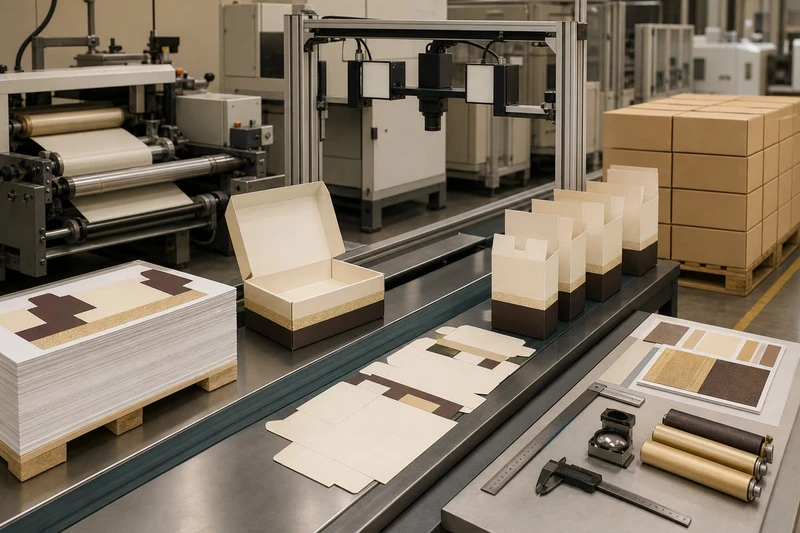
Packaging quality control checkpoints are the planned inspections that compare each production stage with an agreed reference: the approved artwork, material specification, dieline, sample, colour target and pack-out instructions. The strongest plans do not rely on a vague instruction to “check quality”; they state what is being checked, when, against which reference, who makes the decision and what happens if output differs.
For South African brands and packaging buyers, this approach helps prevent costly issues such as incorrect copy, weak cartons, unsuitable finishes, mixed versions or damaged packs arriving at a retailer or fulfilment operation. The exact acceptance criteria should be agreed for the particular product, rather than assumed from generic industry tolerances.
Approve materials and production references
Quality control begins before printing. If the team is working from incomplete artwork, an unclear board description or an unapproved sample, later inspections can only identify problems after material and production time have already been used.
Create a controlled reference pack for every packaging job. It should be available to the people approving materials, running production, checking output and releasing finished cartons.
What the reference pack should include
The content will vary by product, but a practical pack may include:
- Final approved artwork, including the correct version number and revision date
- Dieline or structural drawing showing cut lines, folds, glue areas and safe areas
- Material specification, such as board or paper type, weight, grade, texture and colour where relevant
- Finish specification covering lamination, varnish, foil, embossing, debossing, spot effects or other requested treatments
- Approved digital proof, press proof or physical sample, clearly labelled with its approval status
- Colour references for brand-critical colours, photographs or solid areas
- Copy requirements, including product name, ingredients, barcode, warnings, instructions and country-specific claims where applicable
- Assembly direction for cartons, trays, sleeves, rigid boxes or gift packaging
- Pack-out instructions, including quantities per inner pack and shipper carton, orientation and protection requirements
- Agreed defect categories and release criteria
Treat the approved artwork as a controlled document. A PDF sent informally by email, without a named version or approval record, can easily result in an old design being printed. This is particularly important when product variants have similar designs but different flavours, sizes, language panels, barcodes or legal wording.
Material approval is more than matching a name
Board described simply as “white card” or “kraft” leaves too much open to interpretation. The material reference should make clear the characteristics that affect the finished pack. Depending on the application, those may include stiffness, folding behaviour, surface smoothness, print appearance, opacity, natural shade, grain direction and suitability for the selected finish.
For custom cartons, a packaging buyer should also confirm:
- Structural suitability: Will the selected board support the product weight and shape?
- Finish compatibility: Is the stock appropriate for foil, embossing, lamination or other decorative processes?
- Packing and handling conditions: Will the pack face stacking, rubbing, moisture exposure or repeated opening?
- Product-contact requirements: If packaging directly contacts food, cosmetics or another regulated product, confirm the relevant requirements with the responsible product and compliance teams rather than assuming any standard carton is suitable.
- Consistency expectations: Natural and uncoated papers can have visible variation. Decide whether that variation is acceptable before production.
A physical material swatch or dummy is useful where tactile feel, board shade or folding performance matters. It does not replace the final production reference, but it makes the intended result easier to communicate.
Define what counts as critical before production
Not every difference has the same consequence. Separate defects by risk so inspection effort is focused where it matters most.
| Defect category | Typical examples | Why it matters | Decision approach |
|---|---|---|---|
| Critical | Wrong product information, incorrect barcode, missing mandatory warning, incorrect variant | May create safety, retail, traceability or customer-use risks | Escalate immediately; isolate affected output |
| Major | Significant colour mismatch, poor glue bond, incorrect die-cut, damaged finish, unreadable small text | Can make the packaging unsuitable for sale or normal use | Compare against agreed reference and decide on rework, sorting or rejection |
| Minor | Small non-prominent marks, limited variation in a natural substrate, slight cosmetic differences outside key areas | May not affect function or brand presentation materially | Judge against agreed appearance standard and packing conditions |
These labels are a decision framework, not universal rules. A small mark on a luxury gift box may be unacceptable, while the same mark on a transit carton may be of little consequence. Record the criteria appropriate to the product.
Review first-off output
A first-off review checks the first acceptable production output before the full run proceeds. It is one of the most valuable packaging quality control checkpoints because it connects the approved reference to the actual combination of material, ink, tooling, finishing and converting settings.
Do not treat a first-off as a ceremonial sign-off. Use it to inspect the features most likely to change during production.
First-off checklist
Review the first-off output against the reference pack for:
- Correct artwork version, product variant and language content
- Legibility of small type, reversed-out text, barcodes and fine lines
- Position of graphics in relation to folds, cuts, windows, perforations and glue flaps
- Overall colour appearance and brand-critical colour areas
- Registration of print, foil, varnish or other layers
- Correct substrate and visible surface character
- Accuracy and completeness of finishing effects
- Die-cut shape, creases, scores, tabs and tear features
- Folding and assembly performance
- Glue placement, bond and clean appearance
- Product fit, where a product or representative dummy is available
- Any visible marks, cracking, scuffing, pick-out or unwanted show-through
The reviewer should check both the flat sheet and a formed pack. A panel can look correct before converting but become misaligned, obscured by a fold, or difficult to read once the carton is assembled.
Use the right reference for colour decisions
Colour cannot be judged reliably from an uncalibrated screen, a phone image or memory alone. A signed physical proof, approved production sample or documented colour target provides a much better basis for evaluation.
The agreed reference should state which areas are colour-critical. A logo panel may require close visual matching, while a large photographic background may reasonably show some process variation depending on the material and print method. If metallic, fluorescent or special inks are involved, define how appearance will be assessed under appropriate viewing conditions.
Avoid writing “colour must be perfect” into a specification. Instead, identify the colour areas that matter, select the reference to compare against and agree who has authority to decide whether a difference is acceptable.
Check print finishing and converting stages
Quality can shift after the first-off check. Printing, coating, lamination, foiling, die-cutting, folding and gluing each introduce their own risks. In-process checks help detect drift before it affects a large quantity.
The frequency and depth of inspection should reflect the complexity of the job, the run size, the product’s risk level and the stability of the process. There is no single inspection interval that is right for every packaging order.
Printing checks
During printing, check for changes that affect brand appearance or usability, including:
- Colour drift between early and later output
- Misregistration between colours or print layers
- Dirty print, hickeys, streaks, voids or uneven solids
- Loss of fine detail, especially in small text and barcodes
- Scumming, ghosting or unwanted marks where relevant
- Incorrect variable data, batch information or versioning
- Sheet-to-sheet variation that becomes obvious when packs are displayed together
For packaging with multiple SKUs, keep the approved version identification visible at the inspection point. Similar-looking designs are a common source of mix-ups, particularly where only a small text panel or colour cue distinguishes variants.
Finishing checks
Finishes add visual and tactile value, but they also need their own inspection criteria. Check the feature rather than relying only on a general visual review.
| Finish or process | What to inspect | Common risk to discuss before production |
|---|---|---|
| Lamination | Coverage, edge condition, bubbles, silvering, cracking on folds and surface scuff resistance | Fold stress and edge lifting |
| Varnish or coating | Evenness, gloss or matt appearance, correct placement and cure | Inconsistent sheen, rub-off or unwanted texture |
| Foil | Position, coverage, edge definition and adhesion | Incomplete transfer, misregistration or cracking |
| Embossing/debossing | Placement, depth, sharpness and impact on reverse side | Weak definition or distortion of printed detail |
| Die-cutting and creasing | Cut accuracy, clean edges, crease quality and waste removal | Rough cuts, fractured edges or poorly folding panels |
| Window patching | Film placement, adhesion and cleanliness | Offset patches, lifting or adhesive marks |
| Folding and gluing | Correct fold sequence, glue position, bond and squareness | Open seams, excess glue or incorrect carton formation |
Some effects are intentionally variable. For example, uncoated stock, recycled-content materials and hand-feel finishes may display subtle differences. Make sure the approved reference distinguishes desirable character from unacceptable inconsistency.
Check converting with a functional sample
A die-cut carton should not be approved only as a flat blank. Form several samples and assess how they behave in the real use sequence:
- Fold and close the carton as the packer would.
- Insert the actual product, or a representative sample of the correct dimensions and mass.
- Confirm that closures engage, glue seams hold and panels sit squarely.
- Check that the product does not rattle, crush the pack or make the carton difficult to close.
- Open and close the pack if the consumer will do so.
- Review the finished pack from shelf-facing and handling angles.
This functional check is especially useful for custom printed boxes with inserts, unusual opening mechanisms or premium presentation features.
Inspect assembly and pack-out
A carton can pass print and converting inspection yet still fail at assembly or pack-out. This stage protects the condition and traceability of finished goods before dispatch.
Inspect formed packs at the point where they are assembled, filled or prepared for shipment. If filling is completed by another party, the responsibilities and handover checks should be stated clearly.
Assembly inspection points
Check that:
- The carton is the correct SKU and version
- Panels fold in the intended order and the pack sits square
- Glue seams are secure and clean
- Product-facing panels are correctly oriented
- Inserts, sleeves, labels or stickers are present and correctly positioned
- Opening and closing features work as intended
- No product or assembly process has damaged the print, finish or structure
- Loose fibres, dust, glue strings or other visible contamination are absent where appearance matters
Where labels are part of the packaging system, use a controlled version and placement reference. For custom printed stickers, confirm the text, barcode, adhesive suitability, orientation and application area before full application begins.
Pack-out inspection points
Pack-out instructions should describe more than a count per carton. They should make it possible to reproduce the same protective arrangement consistently.
A pack-out check may cover:
- Quantity of finished units per bundle, inner pack and outer carton
- Correct orientation to reduce rubbing, crushing or edge damage
- Dividers, tissue, sleeves or other protective materials where specified
- Separation of different SKUs, versions or production lots
- Outer carton markings and identification
- Condition of outer cartons, including closure and stacking readiness
- Reconciliation of accepted, rejected, reworked and held quantities
A frequent mistake is inspecting a single attractive retail box but not checking the condition of units taken from the middle or lower levels of a packed shipper. The pack-out method must protect the full quantity, not only the top layer.
Record non-conformance and decisions
A non-conformance is any observed departure from the agreed reference or approved criteria. Recording it is not about assigning blame; it ensures that the team can contain the affected material, make a consistent decision and avoid repeating the same issue.
The record should be practical enough to use on the production floor and clear enough for a buyer or quality representative to understand later.
What to capture in a non-conformance record
Include:
- Job name, product code or SKU and artwork revision
- Date, production stage and relevant batch or lot identification
- Description of the issue and the affected feature
- Photographs or retained samples where useful
- Quantity inspected and estimated quantity affected, if known
- Severity based on the job’s agreed categories
- Immediate containment action, such as hold, segregation or stopping the process
- Decision: accept, sort, rework, remake, use with concession or reject
- Approver and date of the decision
- Root cause and corrective action when investigation is appropriate
Do not make commercial or brand-risk decisions informally. If a variation is accepted as a concession, document who accepted it and for which quantity. That decision should not silently become the standard for future orders.
Separate corrective action from disposal
A hold decision prevents uncertain output from being released. A corrective action addresses why the issue occurred. Both are necessary, but they are different steps.
For example, sorting a batch may remove visibly scuffed cartons from dispatch. It does not explain whether the scuffing came from finishing, handling, insufficient protection or a pack-out method that needs adjustment. The corrective action should focus on preventing recurrence in a subsequent run.
Release finished cartons against agreed criteria
Final release is the formal decision that finished cartons meet the agreed requirements for dispatch or handover. It should be based on documented checks, not on an assumption that no one raised a concern.
Before release, compare the completed order with the reference pack, inspection records and any approved non-conformance decisions.
Final release checklist
A release review should confirm:
- The correct final artwork version and product variants were produced
- Materials and finishes match the approved specification
- First-off and in-process inspections were completed as planned
- Required assembly and functional checks passed
- Pack-out quantity, protection and outer-carton identification are correct
- Non-conforming output is segregated or otherwise accounted for
- Any concessions are written, approved and limited to the agreed scope
- Release records identify the job and relevant production batch or lot
The release authority should be agreed before the job begins. Depending on the organisation, it may be a quality representative, production manager, brand owner or buyer. The key point is that the person has access to the correct reference and the authority to decide.
A simple control-plan format buyers can request
You do not need an overly complex quality manual to improve control. A one-page table can provide a reliable starting point.
| Production stage | Check | Reference | Decision if not met |
|---|---|---|---|
| Incoming materials | Board, paper, adhesive or finish matches specification | Material specification and approved swatch | Hold material and confirm suitability |
| First-off | Artwork, colour, registration, structure and finish | Signed proof, dieline and approved sample | Adjust before full production |
| In-process | Print and finishing remain consistent | Approved first-off and inspection criteria | Contain affected output and correct process |
| Converting | Cut, crease, fold and glue perform correctly | Dieline, assembly sample and fit check | Stop, adjust or segregate output |
| Pack-out | Quantity, protection, SKU separation and markings | Pack-out instructions | Repack or correct identification |
| Final release | Finished order meets agreed criteria | Full job reference pack and records | Release, hold or escalate |
Common mistakes that weaken packaging quality control
Even a detailed specification can fail if the control process is not followed consistently. Watch for these common gaps:
- Approving only artwork: Artwork approval does not confirm material feel, structural performance or finishing quality.
- Using an old proof: References need revision control, particularly for repeat orders and changing product information.
- Checking only appearance: Packaging must also fold, close, protect the product and survive the intended pack-out.
- Leaving acceptance criteria vague: Terms such as “high quality” and “no defects” do not tell inspectors what to compare or how to decide.
- Ignoring variation between SKUs: Similar variants should be positively identified throughout printing, converting and packing.
- Allowing verbal concessions: Any agreed deviation should be recorded with scope, quantity and approval.
- Inspecting too late: Final inspection is important, but earlier checkpoints prevent unnecessary waste and delay.
Frequently asked questions
How many packaging quality control checkpoints are needed?
There is no fixed number. At minimum, most custom packaging projects benefit from material/reference approval, first-off approval, in-process checks, assembly or converting checks, pack-out inspection and final release. Complex packs, regulated content or multi-SKU jobs may need additional checkpoints.
Is a digital proof enough to approve packaging?
A digital proof is useful for copy, layout and artwork version checks. It may not reliably represent substrate colour, ink appearance, finish texture, foil, embossing, fold performance or glue quality. Consider a physical proof or first-off approval where these features are important.
Who should approve the first-off sample?
The appropriate approver depends on the risk. Brand and marketing teams may own visual appearance, while product developers may need to confirm fit and function. Procurement, operations or quality teams may confirm pack-out and agreed acceptance criteria. Set the approval roles before production starts.
Should every carton be inspected?
The inspection approach should be proportionate to the product, process and risk. Some features may need continuous attention during production, while others can be checked through planned sampling. Rather than applying a universal sampling rule, agree the method and escalation process for the specific order.
A clear control plan gives packaging buyers a better way to brief, compare and manage suppliers. Start by gathering the approved artwork, dieline, material and pack-out references, then turn them into stage-by-stage checks before production begins. XGolden Print can support this process when specifying custom packaging, drawing on 27 years of packaging and printing experience.
