
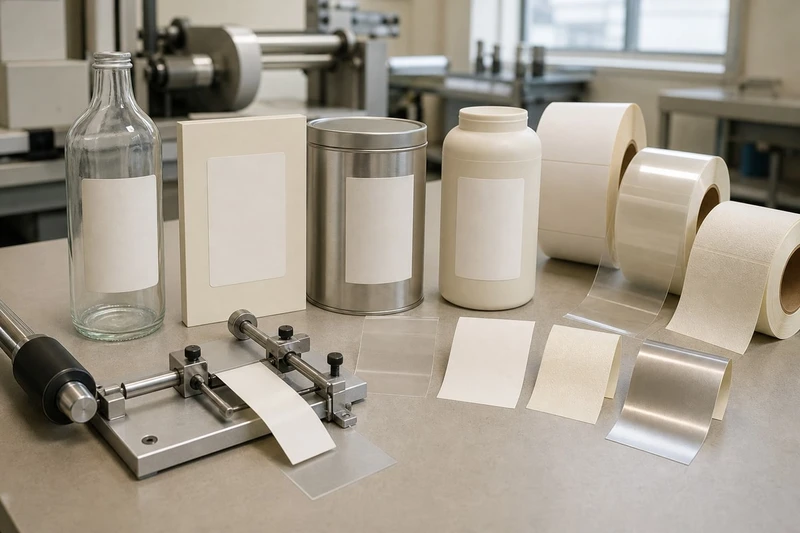
The best label adhesive is the one matched to the actual surface, application conditions and intended end use. A label that sticks well to a clean glass jar may lift from a chilled plastic bottle, while an adhesive that grips corrugated board permanently may damage the pack when removal is required.
For reliable label adhesive selection, identify the substrate and finish first, then assess container shape, temperature, moisture, handling and whether the label must stay permanently or peel away cleanly. Finally, test the complete label construction rather than approving an adhesive from a datasheet alone.
Identify the substrate and surface finish
The substrate is the material to which the label will be applied. Its chemistry, coating and cleanliness have a greater effect on adhesion than appearance alone. Two visually similar packs can need very different adhesive systems.
The main question is whether the surface has high or low surface energy.
- High-surface-energy materials are generally easier for adhesives to wet out and bond to. Glass, aluminium, steel, uncoated paper and many cardboards fall into this group.
- Low-surface-energy materials are harder for conventional adhesives to grip. Polyethylene (PE), polypropylene (PP), some plastic films, waxed materials and certain powder-coated surfaces are common examples.
- Variable surfaces include recycled board, textured moulded plastic and coated cartons. Adhesion can differ between production batches, printing areas or material suppliers.
Adhesive needs are affected by the surface treatment as well as the base material. For example, an untreated plastic bottle, a metallised plastic pouch and a lacquered carton may all need different testing even if their base polymer appears similar.
Common substrates and adhesive considerations
| Surface or pack material | Typical adhesion challenge | Adhesive selection focus |
|---|---|---|
| Glass jars and bottles | Smooth surface; condensation in cold use | Standard permanent adhesive for dry application; moisture-tolerant option for chilled conditions |
| PET bottles | Smooth plastic; possible cold-chain moisture | Adhesive suited to PET and low-temperature or damp handling where needed |
| HDPE and LDPE containers | Low surface energy, especially on flexible bottles | Adhesive formulated for difficult plastics and flexing |
| PP tubs and caps | Low surface energy; curved geometry | Strong initial tack and good adhesion to PP |
| Corrugated board | Dust, fibres, rough texture and uneven surface | Adhesive with good anchorage and conformability |
| Coated cartons | Varnish, aqueous coating or laminate may reduce bond | Test on the exact printed and coated finish |
| Paper bags and uncoated board | Porosity can absorb adhesive | Balance tack with fibre tear and clean removal needs |
| Metal tins | Smooth but may have oils, coatings or condensation | Confirm coating compatibility and application temperature |
| Flexible pouches | Film flexes, wrinkles and may have low-energy layers | Flexible labelstock and adhesive compatible with the outer film |
A label adhesive cannot compensate for a contaminated surface. Dust, silicone, release agents, moulding lubricants, oil, loose fibres and moisture all reduce bond strength. Specify that packs should be clean, dry and handled in a way that avoids contamination before application.
Check the actual finish, not only the material name
A packaging specification that says “PP container” is not enough for final approval. Ask whether it has:
- A textured, matte or gloss finish
- A varnish, lacquer, laminate or coating
- Printed decoration beneath the label area
- Recycled content or a changed resin grade
- A mould-release agent or anti-static treatment
- A seam, embossing or recessed panel
- Exposure to oils, powders or condensation before labelling
Where possible, provide representative production samples to the label supplier. Samples should include the final container, coating, print finish and any realistic storage conditions.
Review flat, curved and tapered geometry
A label may have the right adhesive but still fail because the face material and label shape cannot conform to the pack. Geometry matters most on small-diameter containers, squeeze bottles, tapered tubs and textured or recessed areas.
Flat panels are usually the simplest application. The adhesive can make full contact with the surface, and a paper or film label may perform well if the substrate is suitable.
Curved containers create a tendency for label edges to lift. The tighter the radius, the more important it is to select a label construction that conforms without resisting the curve. Small cosmetic jars, spice containers and narrow bottles often benefit from thinner, more flexible facestocks.
Tapered shapes are more demanding. A rectangular label applied around a conical tub or bottle may wrinkle, flag at the corners or overlap unevenly. An adhesive with high tack can help, but it will not solve a poor label shape.
Match the label format to the container
Consider these adjustments before simply choosing a more aggressive adhesive:
- Use a shorter label width on sharply curved surfaces.
- Specify a curved or tapered label profile for conical containers.
- Choose a thinner film or conformable paper where the pack flexes.
- Avoid placing label edges across ridges, seams, deep texture or moulded lettering.
- Keep a practical margin between the label edge and a container shoulder, base curve or recess.
- Check the label applicator’s wrap pressure and wipe-down settings.
For squeeze bottles, flexible pouches and soft plastic tubes, test the label while the pack is flexed. A label that appears secure on an empty, rigid sample can lift after filling, squeezing or transport vibration.
Define temperature, moisture and handling exposure
Temperature and moisture affect both the moment of application and the label’s working life. These two conditions are often confused, but they should be specified separately.
Application temperature is the temperature of the label and product surface when the label is applied. Adhesives generally form a bond more slowly on cold packs, and some require a minimum application temperature to wet out correctly.
Service temperature is the range the labelled product experiences after application. A product may be labelled at room temperature but later stored in a chiller, freezer, hot warehouse or direct sunlight.
State both conditions in the label brief.
Conditions to define before selecting an adhesive
Record the following:
- Label application environment
Is the line operating in a cool room, standard production area or humid packing space?
- Pack temperature at application
Are bottles or tubs filled warm, ambient, chilled or frozen before labelling?
- Product storage conditions
Will packs be kept on dry shelves, in refrigeration, in a freezer, or in variable warehouse temperatures?
- Moisture exposure
Could condensation form on the pack? Will labels face splashes, ice buckets, rain during distribution or humid cold rooms?
- Handling and abrasion
Will products be frequently touched, stacked, rubbed against other packs or moved through e-commerce fulfilment?
- Chemical contact
Could oils, cleaning products, alcohol, grease, product leakage or plasticiser migration reach the label edge?
For example, a bottled drink labelled before refrigeration may need an adhesive that performs once condensation forms. A dry-goods carton may need less moisture resistance but more resistance to rough warehousing and dust. A beauty product used in a bathroom may need better moisture durability than a display box used only at point of sale.
Avoid applying labels to wet or sweating packs
Many adhesive failures begin when labels are applied over invisible moisture. Condensation creates a barrier between adhesive and substrate, preventing proper contact. Even an adhesive designed for chilled use has limits, so confirm the supplier’s recommended conditions and test on packs straight from the intended process.
If cold packs must be labelled, assess whether the operation can:
- Apply labels before chilling;
- Reduce condensation before application;
- Use a label and adhesive construction designed for cold, damp surfaces; or
- Change the labelling sequence or pack handling method.
Do not assume a label that survives refrigeration can be applied successfully onto a wet refrigerated container.
Choose permanent, removable or repositionable behaviour
Adhesive behaviour should match what the label is meant to do throughout the product’s life. The right choice is not simply “strongest adhesive”; it is the bond that provides the required function without creating disposal, relabelling or residue problems.
Permanent adhesives
A permanent adhesive is intended to remain attached for the useful life of the product. It is commonly used for product identification, retail labels, branded jars, shipping labels and labels that must resist normal handling.
Permanent does not mean it bonds instantly at maximum strength. Many pressure-sensitive adhesives build adhesion over time as they flow into the surface texture. It also does not mean it is suitable for every plastic, wet surface or temperature range.
Choose permanent adhesion when:
- The label must not be removed during retail display or consumer use.
- The pack will face repeated handling, refrigeration or transport.
- Tampering or label replacement would be undesirable.
- Fibre tear on paperboard is acceptable when removal is attempted.
Removable adhesives
Removable labels should peel away with minimal residue and without unacceptable damage to the underlying surface. They are useful for price labels, promotional stickers, temporary instructions, reusable containers and some gift packaging applications.
Removal performance depends on time, temperature and surface type. A label that removes cleanly after one day at room temperature may leave residue after months in heat or may lift too easily in a cold environment.
Choose removable adhesion when:
- The label is temporary by design.
- The pack will be reused or resold without the label.
- The surface must remain presentable after label removal.
- There is a clear maximum dwell time and storage range.
Always define “removable” precisely: clean removal from which surface, after how long, at what temperature, and with what acceptable level of mark or residue?
Repositionable adhesives
Repositionable adhesives allow a label to be lifted and reapplied during application or early use. They can be useful where accurate placement is difficult, such as large-format labels, promotional graphics or manually applied labels.
They are not the same as permanent adhesives with low initial tack. A repositionable construction should be tested for both repeated placement and final edge security. It may not be appropriate for wet, greasy, dusty or heavily handled packs.
Behaviour comparison
| Behaviour | Best suited to | Key risk to test |
|---|---|---|
| Permanent | Product labels, logistics labels, long-life retail packaging | Edge lift, poor adhesion on difficult plastics, fibre tear on removal |
| Removable | Promotions, price labels, reusable packs, temporary messages | Residue, label lift, damage to coatings or printed surfaces |
| Repositionable | Manual placement, alignment-sensitive labels, short-term campaigns | Reduced final bond or premature movement during handling |
If removability matters, test labels on the exact printed coating or laminate. Some varnishes can stain, delaminate or lose gloss when an adhesive is removed, even if the adhesive itself leaves little residue.
Test ageing, edges and residue
A quick peel test on the day of application is useful, but it is not a complete approval method. Adhesive performance changes as the bond develops and as the labelled item moves through storage, transport and use.
A practical test programme should reflect the actual product journey. It does not need to be overly complicated, but it must include the conditions most likely to cause failure.
What to assess during testing
Check the labels immediately after application and again after appropriate ageing periods. Inspect for:
- Edge lift or flagging, especially at corners and container shoulders
- Tunnelling, where the label bridges a curve instead of lying flat
- Wrinkling on tapered or flexible packs
- Adhesive ooze beyond the label edge
- Label movement after application
- Loss of print appearance from scuffing, water or chemicals
- Poor barcode or variable-data readability, if relevant
- Residue after removal
- Damage to coatings, inks, fibres or pack decoration
- Adhesion changes after refrigeration, heat or humidity exposure
For a permanent label, attempt to lift a corner after ageing and note whether failure occurs in the adhesive bond, the face material or the substrate. For a removable label, peel at a consistent angle and speed, then inspect both the label and the package.
Use realistic samples and dwell times
Testing a bare, empty container can miss the conditions that matter. Include filled packs where possible, because product temperature, pack expansion, internal pressure and handling may influence performance.
Also test realistic dwell times. Consider:
- Shortly after application
- After 24 to 72 hours for bond development
- After the expected retail or warehouse period
- After exposure to the warmest, coldest or dampest foreseeable condition
- After transport simulation or normal handling where relevant
No single laboratory-style test can predict every use case. The purpose is to identify foreseeable risks early and agree on an acceptable result before full production.
Approve the complete label construction
Adhesive selection is only one part of the specification. A label is a construction made of face material, adhesive, release liner, print, coating and finishing choices. These elements must work together on the intended application equipment and package.
For instance, an adhesive may suit a PE bottle, but a rigid paper face may still lift on a curved bottle. A film label may conform well, but its print finish may need scuff resistance for frequent handling. A removable adhesive may perform well, but a high-tack laminate or a heavy ink build can affect how the label peels.
Include these details in the approval brief
A useful label specification should cover:
- Exact pack material, supplier and surface finish
- Label application area and container geometry
- Label dimensions, shape and corner radius
- Face material, such as paper, PP film or another suitable stock
- Required adhesive behaviour: permanent, removable or repositionable
- Application temperature and expected storage temperatures
- Moisture, chemical and abrasion exposure
- Whether the pack is rigid, squeezable or flexible
- Print method, inks, varnish, lamination and finishing
- Application method: hand-applied or machine-applied
- Label roll format and dispensing requirements, if machine applied
- Acceptance criteria for adhesion, residue and appearance
- Required approval samples and test conditions
For branded packs, it is worth approving the label as it will be produced rather than approving only unprinted material. Ink coverage, varnish, die-cutting, label size and face material can all alter final performance.
Businesses comparing materials for product identification, promotions or packaging decoration can also review XGolden Print’s custom sticker options alongside the adhesive and application requirements.
Common label adhesive selection mistakes
Avoiding a few recurring mistakes can prevent expensive relabelling, wasted stock and avoidable packaging complaints.
Choosing by substrate name alone
“Plastic” is too broad. PET, HDPE, LDPE and PP behave differently, while coatings and mould-release agents can change adhesion further. Specify the exact material and test it.
Assuming more tack is always better
High tack can be useful on low-energy or rough surfaces, but it can create removal residue, adhesive ooze or difficult application. Match adhesion to the use case instead of choosing the strongest available option.
Ignoring the condition at application
A label applied to a cold, damp bottle faces a different challenge from one applied to a dry ambient bottle. Record the pack temperature and moisture level at the labelling point.
Testing only the centre of the label
Corners and edges are usually the first failure points. Inspect labels around shoulders, seams, taper changes and flexible areas.
Treating removable as a universal promise
A removable adhesive needs defined conditions. Surface finish, dwell time, storage heat and removal speed all affect residue and surface damage.
Changing packaging materials without re-testing
A new carton coating, recycled-content level, bottle supplier or varnish can alter the result. Re-test whenever a relevant component changes.
FAQ
Which adhesive works best on plastic bottles?
There is no single best option. PET, HDPE, LDPE and PP bottles have different surface properties, and bottle temperature, curvature and moisture exposure also matter. Low-surface-energy plastics such as HDPE and PP often need an adhesive designed for difficult plastic surfaces.
Can a permanent label be removed cleanly?
Sometimes, but that is not its intended performance. A permanent label may leave adhesive, damage a coating or tear paper fibres on removal. If clean removal is important, specify a removable adhesive and test it after the expected dwell time.
Why do label corners lift after a few days?
Common causes include insufficient adhesion to the substrate, a curved or tapered surface, a stiff face material, labels applied in cold conditions, contamination, or inadequate application pressure. Check the container geometry and complete label construction, not the adhesive alone.
Does refrigeration affect label adhesion?
Yes. Cold can slow bond formation, and condensation can prevent proper adhesion if labels are applied to wet packs. A label may need to withstand chilled storage even if it is applied at room temperature, so both conditions should be included in testing.
How many samples should be tested?
Use enough samples to cover normal variation in containers, labels and conditions. At minimum, test representative production-style packs across the most demanding anticipated temperature, moisture and handling situations. Larger or higher-risk launches should use a more structured approval plan.
A sound label adhesive selection process starts with the real package and real operating conditions, not a generic adhesive description. Prepare representative pack samples, define the required adhesion behaviour, and approve the complete construction after practical ageing and removal tests. XGolden Print can use those details to help scope a suitable custom label or packaging print brief.
