
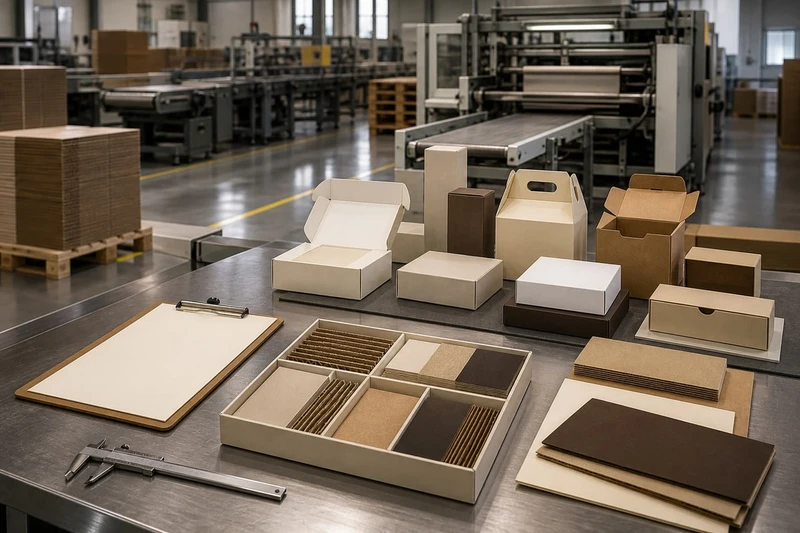
Choosing a packaging supplier is not only about comparing quoted prices or choosing the most attractive box sample. To evaluate a custom packaging supplier properly, assess whether it can repeatedly produce your packaging specification, manage changes clearly, provide meaningful samples, and deliver under agreed responsibilities.
The strongest supplier choice is usually supported by evidence: relevant production examples, a controlled specification, written approvals, clear quality expectations and a first order that tests the real requirements of your product. Use the review process below before committing to a large production run.
Define the capability your project needs
Start with your packaging brief, not the supplier’s sales material. A supplier may produce excellent cartons, for example, but your project may require rigid gift boxes, protective e-commerce mailers, labels that work with your application method, or packaging that holds a particular product securely.
Create a concise requirement sheet before requesting quotations. It gives every prospective supplier the same basis for pricing and helps reveal who asks the right technical questions.
Include the following.
- Packaging format: Folding carton, corrugated shipper, rigid box, sleeve, label, insert, display packaging or a combination.
- Product details: Dimensions, weight, shape, fragility, surface sensitivity and any components packed separately.
- Use case: Retail shelf, delivery to consumers, gifting, subscription packs, transport between warehouses or point-of-sale display.
- Material expectations: Board type, corrugated grade where applicable, thickness or grammage, recycled-content requirements, coatings and finishes.
- Print requirements: Number of colours, brand-critical colours, inside printing, variable information, barcodes, foil, embossing, debossing, varnish or lamination.
- Structural requirements: Closing method, tamper evidence, inserts, dividers, handles, windows, stackability and opening experience.
- Order profile: Estimated quantity per order, expected repeat frequency and whether volume may change seasonally.
- Delivery requirement: Delivery address, whether the goods must arrive palletised or flat-packed, and the date by which they are genuinely needed.
- Acceptance criteria: What must be correct for you to accept the order, including dimensions, print, finish, assembly and packing condition.
Avoid vague requests such as “premium packaging” or “a strong box”. These terms mean different things to different buyers and factories. Define the visible and functional result instead: for instance, “a matte navy rigid box with a secure magnetic closure that holds a 750 ml bottle without movement”.
Match supplier capability to packaging risk
Not every packaging requirement carries the same risk. Consider where failure would be most costly:
| Project requirement | Evidence to request | Risk if not checked |
|---|---|---|
| Exact product fit | Dieline, structural drawing and physical mock-up | Product movement, crushed corners or a box that cannot close |
| Brand-critical colour | Colour target, approved printed proof or press sample | Inconsistent brand appearance across runs |
| Protective transport packaging | Packed product test sample and packing plan | Product damage during handling and distribution |
| Complex finishes | Examples using the same finish on a similar substrate | Cracking, uneven coverage, scuffing or poor adhesion |
| Barcode or variable data | Test artwork and scan verification during approval | Unscannable codes or incorrect product information |
| Repeat ordering | Version control method and retained approved reference | Packaging changes between batches without authorisation |
A supplier does not need to perform every service in-house to be suitable. However, where external processes or supplied materials are involved, ask who coordinates them, who checks the finished result and who is accountable if a component does not meet the approved standard.
For projects involving branded boxes, it can also help to compare available formats and terminology before issuing a brief. See custom packaging box options to frame the type of construction and finish your project may require.
Review relevant production and design evidence
A portfolio can show visual style, but it does not prove that a supplier can manufacture your specific design reliably. Ask for evidence that is comparable in construction, material, finishing process and intended use.
Relevant evidence may include:
- Physical samples of similar box styles or labels.
- Photos showing construction details, including corners, closures, inserts and inside printing.
- Dielines or structural drawings for comparable formats.
- Finished samples with similar print coverage, metallic effects, varnishes or coatings.
- Information about the artwork process, including who checks supplied files.
- A clear explanation of how the supplier handles prototypes, production samples and repeat orders.
Ask practical questions rather than relying on broad claims:
- Have you made packaging with this opening, closure or insert design before?
- What material options suit this product weight and handling method?
- Which aspects of this design are most likely to affect cost, lead time or consistency?
- What artwork format do you need, and what checks do you carry out before production?
- What substitutions might be proposed if a specified material or finish is unavailable?
- Can you provide a sample that represents the actual construction, not only the print appearance?
Check design support, but retain ownership of decisions
Many packaging buyers need help translating a concept into a production-ready layout. That can be useful, particularly when an insert, folding sequence or retail display must work precisely. Still, clarify where supplier support ends and your responsibility begins.
Confirm:
- Who provides the final dieline.
- Whether dimensions are internal, external or both.
- Whether product tolerances have been allowed for.
- Who supplies and approves artwork.
- Which fonts, linked images and colour references must accompany the file.
- Whether edits after artwork approval may affect cost or timing.
- Who holds the approved production files and which revision is current.
A good design discussion should expose possible issues early: tight folds around heavy ink coverage, very small type on textured board, fine foil details, or a window that weakens a structure. It should not replace your own sign-off on the final specification.
Look beyond appearance
A photograph of a polished box cannot confirm board stiffness, glue performance, colour match, dimensional accuracy or performance in transport. Request physical samples where the project value or risk justifies it.
If samples come from another project, treat them as examples of workmanship rather than proof of your final outcome. Differences in artwork, board, finishing, box size and packing arrangement can materially change the result.
Assess specification and change control
The specification is the reference point that prevents a verbal agreement from becoming a dispute. It should be detailed enough for a supplier to produce the work consistently and for your team to inspect the delivery objectively.
A robust packaging specification normally records:
- Product or packaging name and internal SKU.
- Revision number and approval date.
- Box style, dieline version and finished dimensions.
- Material and finish requirements.
- Artwork version and colour references where needed.
- Position and size of labels, barcodes, cut-outs or variable data.
- Product fit requirements, inserts and assembly instructions.
- Quantity, permitted over- or under-supply if applicable, and how it is measured.
- Quality acceptance criteria.
- Packing format, pallet or carton requirements, and delivery details.
Treat every change as a controlled change
Late changes are common: marketing may adjust copy, a product size may shift by a few millimetres, or a retailer may require a different barcode placement. The issue is not that changes happen; it is whether they are recorded, costed and re-approved before production.
Ask each supplier how it handles changes after quotation, after artwork approval and while production is underway. A clear process should identify:
- The requested change and affected files.
- Any consequences for price, materials, tooling, production sequence or timing.
- The revised proof, drawing or sample required.
- The person authorised to approve the change.
- The new revision number used for production.
Do not approve a change through an informal message without ensuring the revised artwork or specification is attached and clearly labelled. Similarly, avoid asking a supplier to “use the last version” when several versions exist. Give the exact file name and revision.
Make communication easy to audit
A supplier can be responsive yet still create risk if instructions are scattered across calls, messaging apps and different email threads. Nominate a decision-maker on your side and ask for one clear contact on the supplier side.
After key calls, send a short written summary covering decisions, open points, owner and due date. This is particularly useful when procurement, marketing, product development and warehousing each influence the packaging.
Evaluate sampling and approval discipline
Sampling is a decision tool, not merely a presentation item. The right sample stage depends on the risk of the project.
For a simple repeat label, a digital artwork proof may be adequate for initial approval. For a new rigid box with foil, an insert and a fragile product, you may need several stages of confirmation before authorising volume production.
Use the right type of proof
| Approval stage | What it helps confirm | What it may not confirm |
|---|---|---|
| Digital artwork proof | Copy, layout, placement, basic visual hierarchy | Final substrate, exact colour, finish and structural performance |
| Plain structural mock-up | Product fit, dimensions, opening and assembly | Final printing and finishing |
| Finished pre-production sample | Print, finish, construction and approximate final appearance | Consistency across the full run unless process controls are also agreed |
| Packed product sample | Product fit, insert performance, packing sequence and presentation | Conditions across every transport route |
| Production reference sample | Standard for comparing supplied goods | It does not remove the need for defined acceptance criteria |
Ask what sample you are receiving and what it is intended to represent. A digitally printed prototype, for example, may be useful for approving design and fit, but may not perfectly match the colour or surface character of a final production method.
Establish a formal approval gate
Before production begins, ensure the supplier has a written release from an authorised person. Your approval should state the item, quantity, artwork revision, relevant sample or proof, and any agreed exceptions.
A practical approval checklist includes:
- Correct product name, SKU and barcode.
- Correct artwork revision and legal or product information supplied by your business.
- Accurate dieline and dimensions.
- Product fits as intended.
- Colours and finishes are acceptable for the agreed reference.
- Folding, gluing, closure and inserts function properly.
- The packaging is packed in the agreed configuration.
- Any approved variation is recorded in writing.
Keep an approved physical sample where possible, labelled with the date and revision. It gives both parties a tangible reference for future repeat orders.
Clarify quality, packing and delivery responsibilities
“Good quality” and “delivery included” are not sufficiently precise commercial terms. Clarify what will be checked, what condition goods should arrive in, and which party is responsible at each handover point.
Agree quality criteria before production
Quality requirements should be appropriate to the item. A premium gift pack may require close scrutiny of scuffing, foil registration and visible glue marks. A plain transit carton may prioritise dimensions, compression resistance and reliable closing.
Discuss and document criteria such as:
- Dimensions and acceptable tolerance, where relevant.
- Colour reference and acceptable variation.
- Registration of print, foil or varnish.
- Die-cut, crease, fold and glue quality.
- Visible defects, including scratches, marks, contamination or delamination.
- Barcode legibility and scan performance.
- Product fit and assembly.
- Quantity verification method.
- Treatment of defects found during receiving inspection.
It is also worth asking when checks occur: at incoming material stage, during production, before packing or before dispatch. Do not assume a supplier follows a particular inspection regime unless it has been specifically confirmed.
Define packing requirements in detail
Packaging can be damaged after it leaves the production line if it is packed poorly for its journey or stored in unsuitable conditions. Confirm whether boxes are delivered flat, assembled, nested, bagged, bundled or packed into outer cartons.
Specify:
- Units per bundle, carton and pallet.
- Maximum carton weight your receiving team can safely handle.
- Whether outer cartons require item identification.
- Whether corner protection, wrapping, dividers or moisture protection are needed.
- Pallet dimensions or height restrictions at your warehouse or retailer.
- Whether mixed SKUs are permitted in one outer carton.
- The condition in which you expect to receive the goods.
For e-commerce packaging, test the full presentation and protection sequence: product, insert, void fill if used, closing method and outer shipping carton. A gift box that looks excellent on a desk may need separate protective handling during distribution.
Confirm delivery and handover terms
For South African buyers, delivery planning can be affected by the distance between the production site, your warehouse, retail distribution point and final assembly location. Build realistic time for approvals, production, collection, line-haul transport and receiving checks.
Ask suppliers to state clearly:
- Whether their quotation includes delivery or collection only.
- The agreed delivery point and receiving contact.
- The planned dispatch date and expected delivery date.
- Who arranges transport and who carries risk at each stage.
- What paperwork accompanies the consignment.
- What happens if receiving is restricted to certain hours or requires a booking.
- How shortages, transit damage or visibly incorrect goods should be reported.
Avoid scheduling a packaging delivery on the same day your filling, kitting or product launch activity begins. Allow time to count, inspect and resolve any issues before packaging becomes operationally critical.
Run a small representative first project
The most reliable way to evaluate a custom packaging supplier is to begin with a project that resembles your intended repeat work, but limits exposure if something goes wrong.
A very small order can be misleading if it uses different materials, printing, finishing or packing from the eventual production run. Instead, make the first project representative of the real requirement where practical.
For example, test the actual box construction, artwork complexity, finish, product weight and delivery format. You may use a lower quantity, but avoid removing the feature that creates the greatest risk.
Score the first project against agreed criteria
Use a simple supplier scorecard after delivery. Involve the people who will work with the packaging: product teams, warehouse staff, marketing, quality reviewers and procurement.
Score each area from 1 to 5, then record evidence rather than relying on general impressions.
| Evaluation area | Questions to assess |
|---|---|
| Brief understanding | Did the supplier identify important requirements and unknowns early? |
| Quotation clarity | Were scope, exclusions, assumptions and delivery terms clear? |
| Communication | Were updates timely, accurate and easy to follow? |
| Technical suitability | Did the material, structure and finish perform as expected? |
| Sampling discipline | Was the approved proof or sample clearly linked to production? |
| Finished quality | Did delivered items meet the agreed visible and functional criteria? |
| Packing and delivery | Did the goods arrive correctly packed, identified and in usable condition? |
| Problem handling | When questions arose, were they documented and resolved constructively? |
A scorecard will not eliminate judgement, but it helps procurement teams compare suppliers fairly. It also creates an evidence base for deciding whether to proceed with a larger order, improve the specification or trial another supplier.
Common supplier evaluation mistakes
Avoid these frequent errors:
- Choosing solely on unit price without comparing material, finishing, packing and delivery scope.
- Sending incomplete artwork or product dimensions and expecting a final quote to remain fixed.
- Approving a screen proof as if it guarantees final print colour.
- Treating a display sample as proof that the product will fit and survive handling.
- Allowing several internal stakeholders to issue conflicting instructions.
- Failing to label artwork, dielines and approvals with revision numbers.
- Leaving delivery responsibilities and receiving requirements until dispatch.
- Moving immediately to a large order before the supplier has completed a representative job.
Questions to ask before placing a custom packaging order
Use these questions as a final supplier review:
- Can you confirm the exact materials, structure, finishes and quantities included in the quotation?
- Which parts of the brief still need confirmation before production?
- What evidence can you provide for comparable work?
- What artwork, dieline and product information do you need from us?
- Which proof or sample stages are available, and what does each stage validate?
- Who can approve artwork, samples and changes on each side?
- How will you identify the production version of the specification?
- What quality criteria will be used before dispatch?
- How will the finished packaging be packed, labelled and delivered?
- What should we inspect on receipt, and how should an issue be reported?
Make a decision based on control, not promises
The best custom packaging supplier for your project is one that can show relevant capability, communicates limitations early and works to a clear approval process. Price matters, but a lower quote can become expensive when it omits packing, uses an unsuitable material, or leaves responsibility for errors unclear.
For buyers seeking a potential packaging partner, learn more about XGolden Print. The business states that it has 27 years of experience, a 15,000 square metre factory, more than 500 employees and production capacity exceeding 10 million units; your own evaluation should still focus on the specific packaging format, specification and order requirements at hand.
Before placing a substantial order, prepare a written brief, request comparable evidence, approve the right sample and use a representative first project to test the working relationship.
