
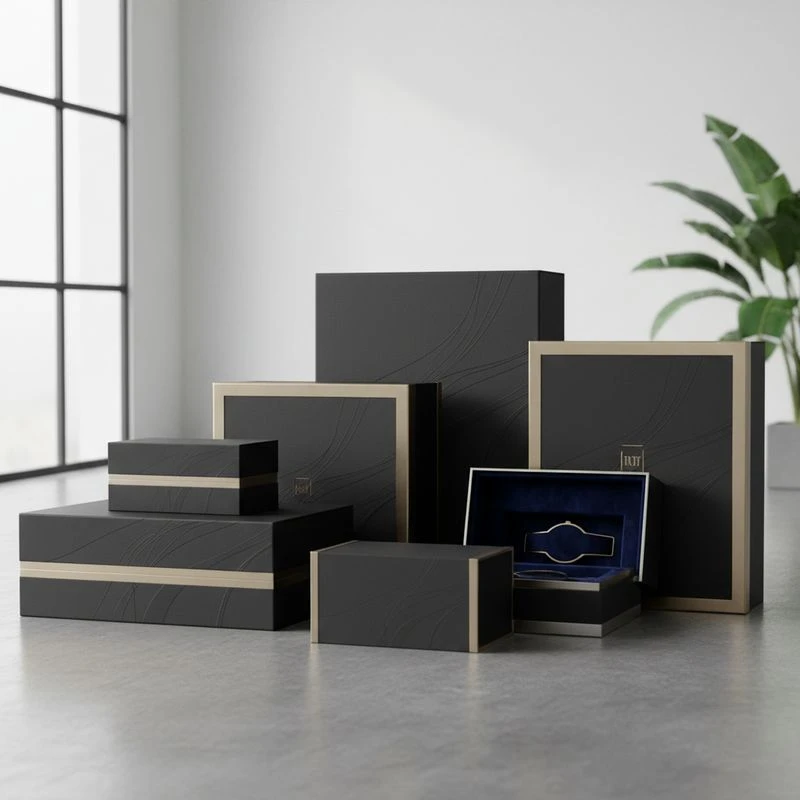
Custom rigid boxes for high end product lines combine durable presentation packaging with a controlled, premium unboxing experience. They are best suited to products where perceived value, gifting, shelf presence and repeatable brand presentation matter as much as basic containment.
Unlike a standard folding carton, a rigid box is made from thick board that holds its form. This makes it a strong choice for premium retail, corporate gifts, beauty products, electronics, jewellery, speciality food gifts and carefully curated e-commerce orders. The right box still needs to be specified around the product, its journey and its retail environment; a beautiful box that is too loose, awkward to open or unsuitable for distribution will not support the customer experience.
Rigid Packaging
Rigid packaging, sometimes called set-up box packaging, is built from dense paperboard rather than a flat carton blank. The board is commonly wrapped in printed paper, coloured paper or another decorative covering. Because the structure arrives assembled, it has a substantial feel and retains its shape during display and handling.
For high-end product lines, custom rigid boxes do more than protect an item. They establish a visual hierarchy: the outside introduces the brand, the opening creates anticipation, and the interior presents the product in its intended position.
Common rigid box styles include:
- Lift-off lid boxes: A separate lid fits over a base. This is a classic option for gift sets, apparel, premium food gifts and retail kits.
- Shoulder and neck boxes: An internal neck or shoulder creates a layered reveal when the lid is removed. It adds visual depth and can improve alignment.
- Magnetic closure boxes: A hinged lid closes against concealed magnets. This format suits presentation packs, corporate gifting and products intended to be kept after purchase.
- Drawer or slide boxes: An inner tray slides from an outer sleeve, often with a ribbon pull. It can create a deliberate reveal for smaller premium products.
- Book-style boxes: A hinged cover opens like a book. This offers broad space for internal messaging, product information or multiple components.
- Rigid tray and sleeve boxes: A sturdy tray is paired with a printed sleeve. This can preserve a premium feel while allowing the sleeve to carry changing campaign or product-range artwork.
The best format depends on how the product will be opened, displayed, replenished and transported. A box for a counter display may prioritise simple access, while a gift set may benefit from a more theatrical opening sequence.
Rigid boxes compared with other packaging types
| Packaging type | Main strengths | Typical limitations | Best fit |
|---|---|---|---|
| Folding carton | Efficient storage before packing, flexible printing options, lighter construction | Less structural presence and lower resistance to crushing than a rigid box | Everyday retail products and lightweight items |
| Custom rigid box | Premium feel, stable form, strong presentation potential and good support for inserts | Uses more material, takes up more storage space and requires careful dimensional planning | Gift packaging, premium ranges, launches and presentation-led products |
| Corrugated shipper | Useful for outer transport protection and bulk distribution | Not usually suitable as primary luxury presentation packaging | Secondary or tertiary protection for packed orders |
| Flexible pouch or bag | Lightweight and adaptable to product volume | Limited structural protection and less formal presentation | Soft goods, refills and selected food products |
Rigid packaging is not automatically the right answer for every premium product. If customers need compact storage, if distribution volume is high, or if the product is low-risk and lightweight, a well-designed folding carton may be a more practical choice. The decision should follow the product and customer journey rather than appearance alone.
Sturdy Design
A sturdy rigid box begins with the right internal dimensions and board construction. The box should support the product without forcing it into place or leaving enough empty space for it to shift. The fit of the lid, tray, sleeve and any insert matters just as much as the outer artwork.
Start by defining the product in its finished sale condition. Include every component that will be in the box, such as:
- The primary product and its own bottle, jar, pouch or container
- Accessories, cables, applicators or replacement parts
- Printed cards, instructions, certificates or promotional material
- Protective bags, tissue, sleeves or seals
- Any product already wrapped for hygiene or presentation
Measure the complete packed product rather than relying on a product drawing or nominal dimensions. Small additions can affect the clearance needed inside the box and can change how an insert performs.
Choose a structure that matches the product
The product’s weight, shape and fragility determine how much support is necessary. A well-fitting rigid box can protect against ordinary handling, but it is not a substitute for a suitable outer shipping pack when parcels travel through a distribution network.
Consider these design questions:
- Where does the weight sit?
A tall bottle, a heavy device or a multi-piece set needs a base and insert that can keep weight balanced. If the centre of gravity is high, the product may need additional restraint.
- How will the customer remove the item?
Deep trays can look refined but make small products difficult to lift out. Finger notches, pull ribbons, side openings or shallow trays can make removal easier without reducing presentation quality.
- Does the item need separation?
Multiple products can knock against one another if they share an open cavity. Dividers or individually shaped insert sections can keep each component in place.
- Will the box be opened more than once?
A reusable gift box needs a closure and construction that remains neat after repeated handling. The opening action should feel intentional, not overly tight or loose.
- Will it be displayed upright, stacked or hung?
Retail display conditions affect the appropriate opening, panel layout and strength requirements. Confirm how the box will sit on shelf and whether it will be stacked in-store.
Inserts provide controlled protection
An insert holds the product in position, frames it visually and prevents it from moving during ordinary handling. It may be made from paperboard, folded board, moulded fibre, foam or other materials chosen for the product and design requirements.
Paper-based inserts can suit brands seeking a coordinated printed or wrapped interior. They can also create dividers, platforms and compartments. Foam may be appropriate where precise cushioning is needed, but its visual and end-of-life implications should be considered carefully. A moulded fibre insert can provide a tactile, natural-looking alternative for some products, though it has its own surface and dimensional characteristics.
Ask for the insert to be designed around the actual product, including tolerances between production units. An insert that fits one sample perfectly may not suit normal variation in product packaging.
Allow for the full delivery journey
A rigid box is primary packaging. For online orders, it usually needs an outer mailing carton or other secondary protection. Even a robust box can be scuffed, compressed or damaged if it travels unprotected with other parcels.
Before finalising a design, consider:
- Handling from packing station to retail shelf or customer
- Whether the product is carried individually or in multipacks
- Exposure to rubbing, pressure, moisture or temperature changes
- The number of handling stages before purchase
- Whether customers may return the product in its original packaging
- Storage space for assembled boxes and packed inventory
For products with regulated labelling, safety information, ingredient lists, warnings or recycling guidance, verify that the final packaging layout includes all applicable information for the intended South African market. Do not assume that a decorative outer box can replace required product information.
Luxury Appeal
Luxury appeal comes from deliberate choices, not from adding every available finish. A premium rigid box should make the product easier to understand, more desirable to give and more satisfying to receive. It should also remain clearly connected to the brand.
The strongest designs usually have one clear visual idea. This might be a distinctive colour field, a textured wrap, restrained metallic detail, a bold typographic treatment or an interior reveal. When too many effects compete, the result can look busy rather than considered.
Build the unboxing sequence
Think about the customer’s experience in order:
- First view: What is visible before the box is touched?
The lid, sleeve or outer panel should communicate the product range and brand with appropriate clarity.
- Opening action: How does the customer access the box?
A lift-off lid, magnetic flap or drawer should open smoothly and suit the product’s price positioning.
- First reveal: What appears immediately inside?
This might be the product, a printed message, tissue paper or a protective card. The reveal should not obscure essential information or make removal difficult.
- Product presentation: How is the item held and framed?
The product should look purposeful in the insert, with no obvious gaps, buckling or loose components.
- After-use value: Is the box likely to be retained?
A reusable box can extend brand visibility, but only if its size, construction and closure make it genuinely useful.
For premium product lines, consistency across sizes is often more valuable than treating each product as a separate design project. A family of boxes can use shared colours, typography, finish locations and structural cues while adapting to different product dimensions.
Match the package to the product category
A high-end skincare set may benefit from a clean, tactile surface and neatly divided interior. A technology accessory may need stronger product restraint and concise instructions. A jewellery box may need a compact form, soft lining or a specifically shaped holder. A food gift range should account for the product’s primary food-safe packaging and any information that needs to remain accessible.
The box should not imply a product feature that is not present. For example, a heavily embellished design may conflict with a minimal, low-waste brand position, while an understated finish may be more suitable for a technical or design-led range. Align structural and visual choices with the product’s actual value proposition.
B2B Manufacturing
For procurement teams and product developers, a custom rigid box project is easier to manage when the brief is detailed before artwork is prepared. The goal is not simply to request a “luxury box”; it is to define a repeatable pack that fits the product, aligns with the brand and works within operational constraints.
A manufacturing brief should include:
- Product dimensions, weight and photographs
- A list of all components going into the box
- Preferred box style and opening direction
- Internal and external dimensions, if already known
- Intended use: retail, gifting, launch packs, e-commerce or corporate distribution
- Required insert type and product orientation
- Artwork files, brand colours and logo usage requirements
- Preferred surface finish and any special effects
- Quantity range and whether there are multiple product sizes or versions
- Packing requirements for the completed boxes
- The target date for artwork approval, sampling and production planning
Where possible, request a physical sample, prototype or structural dummy before committing to a full run. This allows the team to check fit, opening force, insert performance, print placement and visual balance using the real product. Confirm what type of sample is being supplied, as a plain structural sample and a fully finished production-style sample answer different questions.
Questions to ask a packaging supplier
A useful supplier discussion should cover practical details, not only artwork options. Ask:
- Is the proposed construction appropriate for the product weight and opening style?
- What board, wrap and insert materials are proposed?
- How will the lid alignment, magnetic closure or drawer movement be managed?
- What artwork file requirements apply to the chosen printing and finishes?
- Which finishes are suitable for the selected wrap material and design areas?
- Can the product and insert be checked together before final approval?
- How should finished boxes be stored to avoid scuffing, warping or damage?
- What quantity, specification and artwork details must be approved before production?
XGolden Print provides custom packaging boxes and printing solutions. Its experience can be useful when discussing a structured packaging brief, but buyers should still confirm the exact materials, dimensions, finishes, sampling process and commercial terms for their particular project.
For products that do not require a fully rigid structure, it may also be useful to compare custom box packaging options before selecting the final format.
Common specification mistakes
Several avoidable mistakes can weaken a rigid packaging project:
- Designing the artwork before confirming the dieline and opening direction
- Measuring the product without its accessory, protective wrap or instruction card
- Selecting a deep box without planning how the customer will lift out the product
- Using a dark, uncoated surface in an application likely to show scuffs
- Assuming a magnetic closure is suitable for every product weight or shipping condition
- Treating an internal insert as an afterthought
- Using the rigid box as the only layer of protection for e-commerce distribution
- Omitting space for essential product information or variable labels
- Approving a visual mock-up without checking a physical product fit
Finishing
Finishes give custom rigid boxes their visual character and tactile quality. They should be selected early because the chosen wrap, artwork coverage, handling conditions and box format can affect the final result.
Common finishing options include:
- Matt lamination: Creates a smooth, low-gloss appearance that suits understated premium branding.
- Gloss lamination: Produces a reflective surface and can make colours appear more vivid.
- Soft-touch lamination: Gives a velvety feel, often used for refined presentation packaging. Check how it performs with the intended handling conditions.
- Foil stamping: Adds metallic accents to logos, borders or selected details. It works best when used with restraint and clear artwork.
- Embossing and debossing: Raises or recesses design elements for tactile interest. Fine details and very small text may not reproduce as clearly as larger shapes.
- Spot UV: Adds localised gloss to selected printed areas, creating contrast against a matt background.
- Textured or speciality papers: Can add depth without extensive printed effects, although colour matching and surface durability should be reviewed.
- Ribbon pulls or closures: Improve opening and presentation in suitable box styles, but need to be tested with the full structure.
Finishing has practical trade-offs. Large areas of foil, complex textures and multiple processes may affect artwork preparation, lead times, handling sensitivity and overall project cost. A finish should add a clear benefit to the design rather than compensate for weak structure or unclear branding.
When reviewing a sample, inspect it in normal retail and indoor lighting. Check colour, registration, foil placement, edge wrapping, corners, adhesive areas, surface marks and the way the finish looks after repeated opening. Also review the box with the actual product inside, as the interior colour and texture can change the perceived quality of the complete pack.
Frequently asked questions
Are rigid boxes suitable for e-commerce products?
They can be suitable as premium primary packaging, but they generally need secondary protection for parcel distribution. Plan the outer shipper, void fill where necessary and packed-product fit as part of the full packaging system.
What is the difference between a rigid box and a folding carton?
A rigid box is made from thick board and is supplied in its formed shape, while a folding carton is usually supplied flat and folded during packing. Rigid boxes offer more structural presence; folding cartons are often more storage-efficient.
Can rigid boxes be made for small product ranges?
Yes. The practical choice depends on the chosen structure, materials, finishes, quantity and how many sizes are required. A smaller range can benefit from standardised box proportions and shared finishing details.
Should the logo be on every side of a premium box?
Not necessarily. A single well-positioned logo can be more effective than repeated branding. Prioritise the panels customers are most likely to see first and keep the hierarchy clear.
How do I choose the right insert?
Choose an insert based on the product’s shape, weight, fragility, removal method and the number of components. Test it with the finished product and any accessories before approval.
A well-specified rigid box can turn a premium product into a complete presentation experience while supporting practical handling and protection. Start by documenting the product, its components and its customer journey, then compare box structures and finishes against that brief before requesting samples or quotations.
