
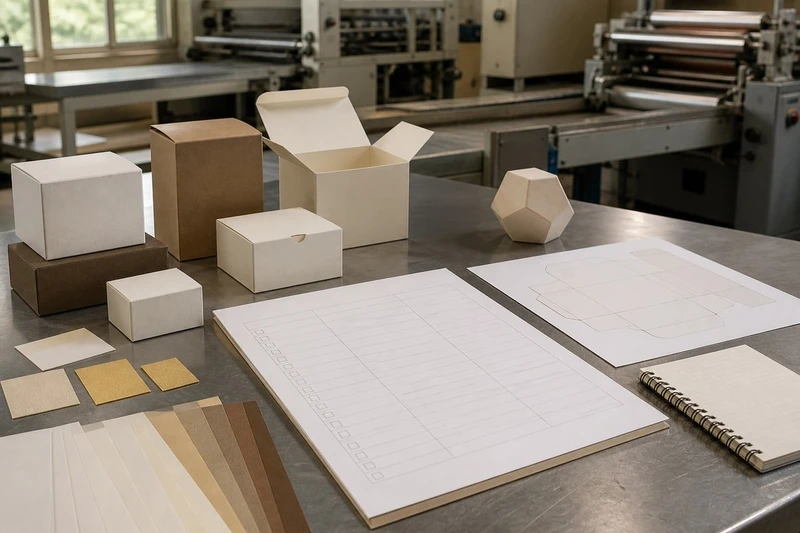
A useful custom packaging brief gives a supplier enough information to assess fit, materials, printing, production steps and delivery requirements without guessing. Before requesting a quote, document six things: the product and sales channel, packed dimensions and risks, order volumes, artwork and finishes, packing and assembly needs, and delivery details.
The more complete the brief, the easier it is to compare like-for-like quotations. It also reduces avoidable revisions, such as discovering late in the process that a box does not fit a courier satchel, a fragile product needs inserts, or supplied artwork cannot support the chosen print finish.
Define the product and sales channel
Start with the product, not the box style. A supplier needs to understand what the packaging must protect, present and communicate. A folding carton for a lightweight retail item has different requirements from a rigid gift box, a shipping mailer or a label for a bottle.
Include a plain-language product description, its use and who will receive it. If there are several product variants, list each one separately rather than assuming one box will suit every SKU.
Your brief should answer:
- What exactly is being packed?
- Is it a single item, a multipack, a set or a subscription bundle?
- Is the product sold in-store, online, through distributors, at events or across several channels?
- Will the outer packaging sit on a shelf, be sent by courier, be displayed in a gift hamper or all of these?
- Does the customer need to open, reseal, reuse or return the packaging?
- Is the box primary packaging around the product, secondary packaging around several units, or an outer transit carton?
Match the packaging format to the route to market
The sales channel affects both the construction and the visual priority of the packaging.
| Sales channel | Main packaging priorities | Details to put in the brief |
|---|---|---|
| Retail shelf | Shelf presence, product information, barcode area, consistent dimensions | Retailer requirements, display orientation, hanging or stacking needs |
| E-commerce | Product protection, efficient shipping size, unboxing experience | Courier handling expectations, outer mailer needs, void fill and return process |
| Corporate gifting | Presentation, premium feel, assembly quality | Contents list, insert layout, personalisation and packing sequence |
| Wholesale or distribution | Stackability, batch identification, efficient packing | Units per shipper, carton markings, pallet or warehouse handling requirements |
| Food, cosmetics or wellness products | Label space, product information and compatibility considerations | Container material, label surface, information that must appear and exposure to moisture or oils |
A branded box may be enough for some products. Others need a combination of a printed box, protective insert and custom stickers and labels for variants, sealing or batch identification. State which components you are asking a supplier to quote for, and which ones are already sourced elsewhere.
Specify what the packaging must achieve
Avoid broad phrases such as “premium packaging” or “strong box” on their own. Turn them into practical objectives. For example:
- “The packaging must protect a glass jar during normal courier handling.”
- “The product must be visible through a window on a retail shelf.”
- “The box should be gift-ready, with no additional wrapping required.”
- “The carton must fit into the client’s existing dispatch carton.”
- “The opening should make the product easy to remove without tearing the box.”
If appearance matters most, say so. If cost control, product protection, speedy packing or compact storage is the priority, say that too. Trade-offs are normal: a more elaborate structure, heavier board, special finish or hand assembly can affect cost, lead time and packing efficiency.
Record dimensions, weight and fragile points
Accurate product measurements are the foundation of a workable packaging quote. Give the actual packed product dimensions, not an estimate based on a website listing or a similar item.
Measure the product at its widest, tallest and deepest points, including caps, handles, cables, pumps, protrusions and any protective wrapping already needed. Record dimensions in millimetres as length × width × height, and clearly state the order you are using.
For round or irregular products, provide the diameter, height and a photo or technical drawing where possible.
Information to record for every product
Include the following in your custom packaging brief checklist:
- Product dimensions: L × W × H in mm
- Product weight, preferably in grams or kilograms
- Product shape: rectangular, cylindrical, tapered, irregular or flexible
- Material: glass, ceramic, metal, plastic, paper, fabric or mixed materials
- Existing packaging: bottle, pouch, jar, sleeve, bag, blister or none
- Number of units per box
- Whether items touch each other inside the pack
- Required orientation: upright, flat or either
- Temperature or moisture sensitivity, if relevant to storage and transport
- Any sharp corners, delicate closures, loose components or easily scuffed surfaces
Identify fragile points rather than simply calling an item fragile
“Fragile” is a useful warning, but it does not tell a packaging designer what needs protection. Describe the failure risk.
Examples include:
- Glass corners or bases that can chip
- A pump, nozzle or lid that may snap
- A glossy surface that scratches easily
- A ceramic handle that needs clearance
- Printed edges that can rub during transit
- A product that leaks if stored on its side
- Multiple components that can collide inside the box
Photographs of the product from several angles are particularly useful. If an existing carton has failed, explain how it failed: crushing, breakage, movement, scuffing, opening in transit or poor shelf presentation. This gives the supplier a clearer starting point than asking for “something stronger”.
Include both inner and outer dimensions
A common mistake is to provide only the desired external size of a box. Packaging is designed around the product’s internal space requirement, board thickness, folds and inserts. A nominal outside size may not leave enough room for the product.
Where relevant, ask for confirmation of:
- Internal box dimensions
- External assembled dimensions
- Flat-packed dimensions for storage
- Tolerance expectations for fitted items
- The effect of inserts, dividers, tissue or protective wrap on available space
Do not specify an extremely tight fit unless you have allowed for normal manufacturing tolerances and the way the product will be packed. A close-fitting box can look neat but become difficult for staff to assemble or for customers to open.
Set quantity and repeat-order expectations
Quantity influences nearly every commercial decision in packaging: format, print method, material sourcing, setup work, unit cost, storage and replenishment. Give an honest indication of your first order and expected repeat orders, even if the forecast is still provisional.
A quote for 500 boxes can be materially different from a quote for 5,000 boxes, not only in unit price but in what construction and finishing choices are practical.
State quantities in a way suppliers can use
Separate the quantities below:
- Initial order quantity – the amount you are ready to purchase now.
- Quantity by design or SKU – especially where sizes, colours or wording differ.
- Expected repeat volume – monthly, quarterly, seasonal or as needed.
- Annual estimate – if you have one, marked as an estimate rather than a commitment.
- Test or launch quantity – if you need a small run before wider rollout.
For example, “3,000 total units” is incomplete if there are three box sizes and two artwork versions. Instead, write: “1,000 units per size; the same artwork structure, with different product names.”
Explain demand patterns and storage limits
South African buyers often need to balance better unit economics against limited warehouse or office space. Tell the supplier if you need deliveries in batches, have a fixed storage footprint, or are planning around a campaign, launch or retail reset.
Useful details include:
- Required delivery date or date range
- Whether the date is fixed or flexible
- Seasonal peaks, promotional periods or launch dates
- Maximum number of cartons you can store
- Whether repeat orders need the same specifications
- Whether future artwork changes are likely
Do not treat a repeat-order forecast as a guarantee. It is planning information. Conversely, do not omit it entirely: knowing that a product is likely to reorder can help a supplier discuss the most sensible long-term approach.
Describe brand artwork and finish needs
Artwork affects more than visual appeal. It determines print colours, legibility, finishing options, the suitability of supplied files and the amount of pre-production work required. State what is ready, what is still in development and who has approval authority.
A packaging supplier can assess the physical packaging more accurately when they know whether the design is a simple one-colour mark, a full-colour retail layout, a design with metallic effects, or a versioned range with variable details.
Provide the right artwork information
Your brief should include:
- Brand logo files and applicable brand guidelines
- Artwork file format and whether it is final or draft
- Box panels requiring print: outside, inside, base, lid or all panels
- Number of colours and any brand colour references
- Product names, variants and language versions
- Barcode, QR code or variable-data requirements
- Mandatory copy supplied by your business or product team
- Whether the supplier needs to create or adapt dielines
- The person responsible for approving proofs
Use high-resolution, editable artwork where available, but do not assume every file is production-ready. Ask what format, colour setup, bleed, safe area and dieline requirements apply before finalising artwork. Fine type, thin lines, small reversed-out text and details placed near folds may need adjustment for reliable printing.
Specify finishes by purpose
Describe the intended result and not only the finish name. “Luxury” can mean different things to different teams. Say whether you want a soft-touch feel, a matt look with high-contrast details, a tactile logo, a metallic highlight or a surface that is easier to wipe clean.
Possible requirements to discuss include:
- Matt, gloss or uncoated appearance
- Lamination or coating
- Foil details
- Embossing or debossing
- Spot gloss effects
- Window cut-outs
- Coloured edges, ribbons, magnets or closures
- Interior printing
- A blank area for hand-written messages or applied labels
Every finish has limitations. Some can add cost or production stages; some are less suitable for highly textured artwork, tight folds or packaging that will receive frequent abrasion. Ask to review a proof, mock-up or relevant sample process before committing to a final design, particularly where colour matching or a tactile finish is important.
For presentation-led products, explore appropriate custom gift packaging options only after confirming the product dimensions, opening style and assembly method. A visually attractive concept is not useful if it slows packing or does not protect the contents.
Confirm packing, assembly and delivery requirements
Packaging can be supplied flat, partly assembled or fully assembled. The right option depends on storage space, staffing, packing speed, product fragility and delivery method. Add this to the brief early, because an assembly requirement can change the practical design.
Decide who assembles and packs the packaging
State clearly whether:
- Your team will assemble boxes on site
- A contract packer will fill the boxes
- Boxes need to arrive pre-assembled
- Inserts must be fitted before product packing
- Products need to be packed into boxes as part of the scope
- Labels, seals, tissue, ribbons or other components must be applied
- A packing guide is needed for a multi-part presentation set
If your own team will assemble boxes, ask for a design that matches its capability and available time. A complex rigid box or multi-piece insert may be suitable for a small premium run, but less practical for a busy e-commerce fulfilment operation.
Describe the delivery point and handling constraints
Delivery is part of the specification, not an afterthought. Provide the full delivery suburb and postal code, preferred receiving hours, contact person, and any meaningful access conditions. For example, a warehouse with loading facilities has different receiving needs from a small office, home business or retail unit.
Also confirm:
- Whether delivery is to one address or multiple locations
- Whether packaging must be delivered flat-packed or assembled
- Whether cartons need product labels, SKU names or carton counts
- Whether deliveries must be split by branch, campaign or product variant
- Whether the receiving site has limits on carton size or pallet handling
- Whether packaging will be transferred onward by your own courier or distributor
If boxes will be used for e-commerce dispatch, distinguish between the customer-facing pack and the outer shipping carton. A beautiful product box may still need an appropriately sized transit solution and protective materials. When comparing suppliers, check that you are comparing the same scope.
Build the final supplier handover checklist
Use this final checklist before sending a request for quotation. Attach product photos, sketches, artwork and any existing packaging photos rather than burying important details in an email thread.
Product and packaging scope
- [ ] Product name, SKU and a short description
- [ ] Product photos or drawings
- [ ] Product dimensions, weight and shape
- [ ] Material and fragile points
- [ ] Units per pack and required orientation
- [ ] Required packaging format: box, sleeve, mailer, insert, label or combination
- [ ] Product-facing, retail, gift or transit packaging purpose
- [ ] Existing packaging problems or non-negotiable requirements
Dimensions and protection
- [ ] Required internal dimensions, where known
- [ ] Desired external dimensions, where relevant
- [ ] Need for an insert, divider, window, cushioning or void fill
- [ ] Products that must not touch each other
- [ ] Opening, resealing or tamper-evident needs
- [ ] Courier, warehousing or shelf-display handling considerations
Quantity and commercial planning
- [ ] Initial order quantity
- [ ] Quantity per SKU, size, colour or artwork version
- [ ] Expected repeat-order pattern
- [ ] Target launch or required delivery date
- [ ] Storage constraints and whether split deliveries are needed
- [ ] Budget range, if you are comfortable sharing one
- [ ] Request for itemised options where materials or finishes are still undecided
Artwork and finish
- [ ] Logo, brand guide and artwork files attached
- [ ] Draft artwork clearly marked as draft
- [ ] Print locations and number of artwork versions listed
- [ ] Colour references and finish preferences stated
- [ ] Barcode, QR code, legal copy and variable details supplied where applicable
- [ ] Proof approval contact and approval process identified
- [ ] Questions about dielines, file preparation and colour reproduction included
Assembly and delivery
- [ ] Flat-packed, pre-assembled or packed-product requirement confirmed
- [ ] Who will assemble, fill and seal the packaging is stated
- [ ] Required packing sequence for sets or gift boxes is included
- [ ] Delivery address, receiving contact and delivery constraints supplied
- [ ] Carton labelling, SKU separation and split-delivery requirements listed
- [ ] Request for samples, prototypes or production proofs noted where needed
Common briefing mistakes that lead to weak quotations
A supplier can quote only against the information available. These frequent omissions make comparison difficult:
- Asking for a price without a quantity. Unit cost is closely tied to order volume.
- Providing product dimensions but no weight or material. This can overlook protection needs.
- Calling a finish “premium” without examples. Define the look, feel and use case instead.
- Leaving artwork versions unspecified. Different SKUs and language versions can affect setup and production planning.
- Confusing the product box with the shipping carton. They perform different jobs.
- Requesting an exact delivery date without sharing it at the start. Timing should be part of the initial discussion.
- Comparing totals rather than scope. One quote may include inserts, delivery or finishing while another does not.
- Skipping approval responsibilities. Identify who signs off dimensions, artwork and samples before production.
FAQ
Do I need final artwork before requesting a packaging quote?
No. A draft layout, logo and description of colours and finishes can be enough for an initial estimate. However, final artwork or a confirmed print specification is normally needed before production can be properly approved. Make it clear which elements are still subject to change.
Should I share my budget with a packaging supplier?
It can be helpful when presented as a target or range rather than a fixed demand. A budget allows a supplier to suggest realistic alternatives in board, construction, print coverage or finishes. If you prefer not to share one, ask for tiered options based on different quantities or specifications.
What should I compare between custom packaging quotes?
Compare the full specification: box style, dimensions, board or material, print coverage, finishes, inserts, assembly state, quantity per version, proofing, packing method and delivery scope. The lowest total is not necessarily the lowest comparable price if key components have been excluded.
When is a physical sample worth requesting?
A sample is especially useful for fitted packaging, fragile or heavy products, complex gift sets, unusual opening mechanisms, important brand colours and finishes that need to be felt or seen in person. Confirm what type of sample is possible and what it will represent, as a prototype may not exactly match a final production run.
A complete brief gives you a stronger basis for supplier discussions and a fairer quotation comparison. When you are ready to turn your requirements into a box specification, review the available custom box packaging formats and send the checklist with your product details.
