
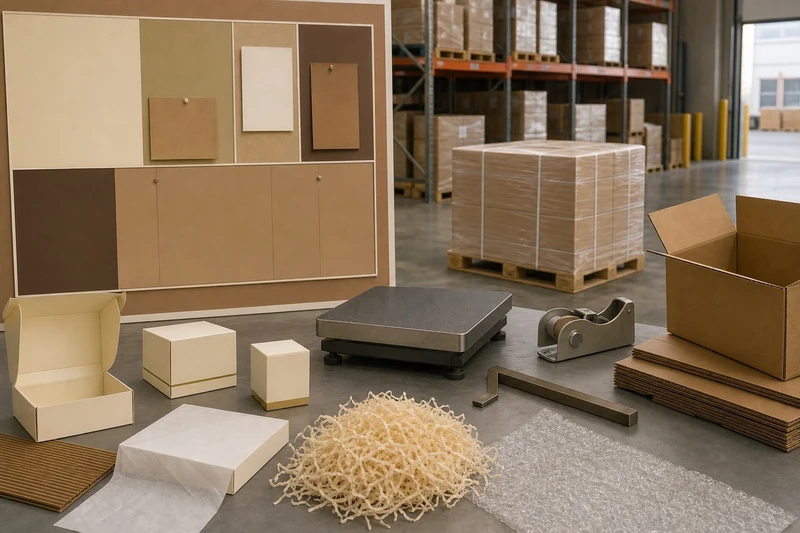
The total landed cost of custom packaging is the full cost of getting usable packaging into your South African operation—not simply the supplier’s price per box. It includes product cost, samples, tooling, export packing, freight, import charges, delivery, warehousing, losses and any work needed before the packaging can be used.
A lower unit quotation can therefore be more expensive overall. To compare suppliers fairly, calculate each option using the same specification, order quantity, shipping method, Incoterm, destination and time period.
A practical formula is:
Total landed cost = product costs + one-off costs + logistics costs + import and local charges + receiving/storage costs + expected loss + preparation costs
Then calculate:
Landed cost per usable unit = total landed cost ÷ usable packaging units received
“Usable” matters. Damaged, incorrectly assembled, unsuitable or obsolete packs should not be treated as stock available for sale.
Start with the complete product specification
A meaningful landed-cost comparison starts before pricing. If each supplier is quoting a different box, label or gift pack, their unit prices cannot be compared directly.
Create one written packaging specification and send it to every prospective supplier. For custom packaging boxes, the specification should cover both the physical construction and the printed finish.
Include the following details.
| Specification area | What to define |
|---|---|
| Packaging format | Carton, mailer, rigid box, sleeve, folding box, label, insert or gift packaging |
| Internal and external dimensions | Length, width and height; state whether dimensions are internal or external |
| Material | Board grade or type, paper wrap, corrugated flute where relevant, and required strength |
| Structure | Tuck-end, crash-lock, magnetic closure, drawer, lid-and-base, self-locking or another format |
| Number of colours, print sides, artwork version, branding inside the box and variable information | |
| Finish | Matte or gloss lamination, varnish, foil, embossing, debossing, spot effects or window patches |
| Inserts and accessories | Dividers, trays, tissue, ribbons, handles, magnets, labels or protective wraps |
| Packing method | Units per inner pack, cartons per pallet, carton dimensions, palletisation and protection |
| Quantity | Required order quantity, split quantities by SKU and any repeat-order forecast |
| Acceptance criteria | Colour tolerance, visible finish expectations, fit with the product and permissible defects |
For a product that needs a close fit, supply the actual product, a technical drawing or a reliable dummy. A box that looks right but does not accommodate the product, leaflet, accessories or protective insert is not a lower-cost option—it is unusable inventory.
Confirm the shipment measurements, not just box dimensions
Freight can be driven by volume rather than weight, particularly for lightweight but bulky presentation packaging. Ask every supplier to quote:
- gross shipment weight;
- total number of export cartons;
- dimensions of each export carton;
- total cubic metres;
- pallets, if applicable;
- units per carton; and
- whether the quoted pack-out includes individual protection or assembly.
This information makes it possible to compare freight quotations on a like-for-like basis. It also shows whether a small packaging redesign could reduce shipping and storage costs. For example, a flat-packed carton may cost more to assemble locally, while a pre-assembled rigid box may use considerably more freight volume.
Separate tooling, sampling and unit costs
Custom packaging quotations often combine recurring and once-off charges. Separate them before deciding which supplier has the lowest price.
One-off costs
One-off costs may include:
- cutting dies or tooling;
- printing plates, where applicable;
- embossing, debossing or foil dies;
- structural development;
- plain or printed samples;
- pre-production samples;
- artwork adaptation or file preparation; and
- sample courier charges.
These costs should be recorded separately from the production order, even when a supplier includes them in the quoted unit price. They may be paid once, charged again for a redesign, or recovered across a limited number of orders. Confirm ownership, storage period and any future-use conditions for tooling rather than assuming it remains available indefinitely.
Recurring unit costs
The recurring price should be based on the final production specification and quantity. Check whether it includes:
- all printing and finishes;
- inserts and accessories;
- individual packing, if required;
- export cartons;
- palletisation;
- quality inspection or sorting, if quoted separately; and
- delivery to the agreed handover point.
A useful way to assess the commercial impact of one-off costs is to spread them over the realistic lifetime volume of the design.
Amortised one-off cost per pack = total one-off costs ÷ expected total units using that design
Do not spread a die cost across an optimistic volume forecast if the packaging is seasonal, subject to frequent artwork changes or tied to a short product launch. In those cases, use a conservative volume estimate.
A simple quote worksheet
Use this structure for every quote:
| Cost line | Supplier A | Supplier B | Notes |
|---|---|---|---|
| Production units | Same approved specification and quantity | ||
| Unit production price | Exclude or identify taxes clearly | ||
| Tooling and dies | One-off or repeatable charge? | ||
| Samples and courier | Approval sample included? | ||
| Export packing | Included, excluded or estimated | ||
| Freight | Same transport mode and destination | ||
| Import and local charges | Based on the same assumptions | ||
| Local delivery | Delivery point defined | ||
| Storage and handling | Estimated for the same holding period | ||
| Assembly or kitting | Labour, consumables and supervision | ||
| Expected loss allowance | Damage, rejects and obsolescence | ||
| Total landed cost | |||
| Cost per usable unit |
Include packing, freight, duties and local charges
The production invoice is only one portion of the total. A complete model should identify every cost from factory dispatch to your receiving location in South Africa.
Define the delivery term first
The agreed Incoterm determines which party is responsible for stages such as collection, export clearance, main freight, insurance, import clearance and delivery. Do not compare a quote delivered to a port with one delivered to your warehouse as if both include the same services.
For each quote, record:
- named origin and destination;
- the stated Incoterm and version;
- freight mode: courier, air, sea or road where applicable;
- whether cargo insurance is included;
- whether export documentation is included;
- who appoints the freight forwarder;
- who acts as importer of record; and
- the point at which responsibility transfers.
If a term is missing or vague, treat the quote as incomplete until it is clarified.
Freight and shipping-related charges
Depending on the route, mode and service provider, total freight expense can include more than the headline transport amount:
- collection from the factory;
- export packing and palletisation;
- origin terminal or handling charges;
- sea freight, air freight or courier charges;
- cargo insurance;
- destination terminal charges;
- documentation and release fees;
- customs-clearing fees;
- delivery to your warehouse; and
- detention, demurrage or storage costs if cargo is not cleared promptly.
Request a freight quote that distinguishes included services, estimates and exclusions. Freight is time-sensitive, so use a current quotation for a buying decision and record the date rather than treating a previous shipment cost as fixed.
Duties, import VAT and customs classification
Import duty, VAT treatment and other border charges depend on factors such as the product classification, material composition, declared customs value, origin and current rules. Packaging made from different materials can have different classifications, and a printed folding carton may not necessarily be treated the same way as a rigid gift box or a roll of labels.
For budgeting purposes, obtain a classification and charge estimate from a qualified customs broker, clearing agent or other appropriate adviser. Confirm:
- the likely tariff classification;
- the declared value basis;
- country-of-origin information;
- whether documentary proof of origin is needed;
- duty and tax treatment applicable to your transaction;
- clearing fees; and
- whether any amounts can be recovered by your business under its own tax position.
Do not insert a generic duty percentage or tax figure into a packaging business case. Rates and treatment can change, and the correct answer depends on the actual goods and import arrangement.
Local receiving costs are often overlooked
Once goods arrive, costs may still arise before packaging reaches the production line or fulfilment area. Include estimates for:
- offloading;
- warehouse receiving and count checks;
- pallet handling;
- internal transport;
- storage;
- picking and replenishment;
- stocktaking; and
- disposal or recycling of transit materials.
These costs are especially relevant for bulky, low-value-per-cubic-metre packaging such as assembled presentation boxes.
Model storage, damage and assembly costs
The lowest delivered cost is not automatically the lowest cost to use. Packaging may need space, labour or extra components before it is ready to protect and present the product.
Storage and inventory carrying cost
Custom packaging is often ordered in larger quantities to reach a better unit price. That can be sensible, but only if the savings exceed the cost and risk of holding stock.
Estimate storage with:
Storage cost = average pallets or cubic metres held × storage rate × months held
Also consider the cost of capital tied up in inventory, insurance if relevant to your operation, and the chance that stock becomes obsolete after a design, legal copy, product size or campaign change.
A supplier with a slightly higher unit price but a lower minimum order quantity may be more economical when demand is uncertain.
Damage, rejects and loss allowance
Build an explicit allowance for loss instead of assuming every delivered unit will be saleable. Potential losses include:
- transit crushing, scuffing or moisture exposure;
- print or finish defects found during receiving;
- incomplete accessory sets;
- damage during internal handling;
- assembly errors;
- stock contamination; and
- obsolete packaging that can no longer be used.
Use your own historical data where possible. If you do not have it, make a cautious planning assumption and label it clearly. The aim is not to predict defects precisely; it is to prevent a comparison from assuming a zero-loss outcome without evidence.
A practical calculation is:
Usable units = units received − rejected units − damaged units − expected obsolescence allowance
Then divide total cost by usable units, not ordered units.
Assembly and kitting
Flat-packed boxes can reduce inbound volume. However, the savings may disappear if local assembly is slow, inconsistent or requires additional storage space.
Calculate assembly cost as:
Assembly cost per unit = labour time per unit × fully loaded labour cost per hour + consumables + quality checks
Include training, line supervision and the cost of rework where the structure is complex. If packaging must be assembled around the product, consider whether it suits the available packing line, fulfilment process or retail preparation workflow.
For e-commerce packaging, test the whole process: picking the pack, assembling it, inserting the product and documentation, closing it and applying any label. A design that adds only a few seconds per order can become material at scale.
Compare scenarios on the same basis
A reliable decision compares realistic alternatives rather than selecting the lowest visible number on a quotation.
Start by choosing a single comparison basis:
- same packaging specification;
- same order quantity or clearly stated quantity tiers;
- same delivery destination;
- same date range for freight estimates;
- same currency conversion assumption if currencies differ;
- same customs and local-charge assumptions;
- same planned storage period; and
- same definition of usable units.
Example scenario framework
Instead of relying on one “best price”, prepare at least three scenarios:
| Scenario | Best for | Key question |
|---|---|---|
| Small initial order | New launches and uncertain demand | Does lower inventory risk justify a higher unit cost? |
| Standard replenishment order | Established products | What is the full recurring cost per usable pack? |
| High-volume order | Predictable demand | Do production savings exceed storage, cash-flow and obsolescence risk? |
| Pre-assembled versus flat-packed | Operationally complex packs | Is freight saving greater than local assembly cost? |
| Sea freight versus air freight | Time-sensitive stock | Is faster availability worth the additional transport cost? |
Use a spreadsheet with a visible assumptions tab. Change only one variable at a time where possible. For example, keep the same packaging specification but compare two quantities; then keep quantity constant while testing flat-packed and assembled formats.
Consider timing and cash flow separately
Landed cost tells you what packaging costs in total. It does not fully show when cash is required.
Add a simple cash-flow view showing deposits, balance payments, freight payment, import charges and local delivery costs. A purchase that appears cheaper over a year may require more cash upfront and leave the business holding more packaging inventory.
For a retail launch, also consider the cost of a late pack: emergency freight, delayed product dispatch, temporary substitute packaging or manual relabelling. These are scenario risks, not guaranteed outcomes, but they belong in a practical decision.
Record assumptions and quote exclusions
A landed-cost model is only as credible as its assumptions. Keep a short record alongside every comparison so that finance, procurement, marketing and operations can understand what has been included.
Your assumptions register should state:
- quotation date and validity period;
- supplier name and quotation reference;
- packaging version, artwork revision and quantity;
- currency and exchange-rate assumption;
- Incoterm, origin, destination and freight mode;
- freight quotation date;
- shipment weight, carton count and cubic volume;
- customs classification assumption and source of advice;
- estimated duties, taxes and clearance costs;
- storage period and rate used;
- expected damage, reject and obsolescence allowance;
- local assembly time and labour-cost basis;
- included and excluded accessories;
- delivery point; and
- responsibilities for approval samples, tooling changes and artwork corrections.
Common quote exclusions to check
Before approving a supplier, ask whether the quotation excludes any of the following:
- sample or courier fees;
- tooling, plates or dies;
- colour matching or special finishes;
- artwork changes after approval;
- export cartons or protective packing;
- pallets;
- freight and insurance;
- import duties, taxes and clearance;
- destination terminal charges;
- warehouse delivery;
- offloading;
- assembly, kitting or label application;
- storage;
- replacement of damaged units; or
- disposal of obsolete stock.
An exclusion is not necessarily a problem. It simply needs a cost owner and a value in your model.
A practical final check before placing the order
Before choosing a custom packaging quote, verify these five points:
- The products are genuinely equivalent. Materials, dimensions, print, finish, inserts and packing method match the approved specification.
- One-off and recurring charges are separated. You can see both the first-order cost and repeat-order cost.
- The logistics scope is clear. The delivery term, handover point and every major freight responsibility are documented.
- The result is cost per usable pack. Storage, damage, assembly and likely local handling have not been ignored.
- The assumptions can be challenged. Freight, import treatment, exchange rates and demand forecasts are current enough for the decision.
If you are at the specification stage, start by defining the box structure, material, finish and pack-out before collecting quotations. XGolden Print’s custom box options can help frame the product details you need to compare suppliers on a consistent basis.
